Since 2007, Eva Parey has been building a visual archive of the communities that inhabit the Besòs territories, tracing the social, cultural and urban transformations that have shaped the metropolitan periphery of Barcelona. From the river's mouth to the mountain slopes, Cartografia Besòs draws a human map of a territory marked by displacement, roots and survival strategies. Beyond its specific geography, the project invites reflection on phenomena that cut across many contemporary cities: the capacity to welcome in the face of demographic growth, identity and social inequalities.Between the 1950s and 1970s, the massive arrival of population from other territories of the Spanish State transformed Barcelona and its metropolitan area. Industrial and demographic growth drove an accelerated expansion marked by urban developmentalism. On former farmland and riverside landscapes, where poplars once abounded, large housing estates grew up, some intended to house families from the shanty settlements of the "informal Barcelona".At the beginning of the 21st century, new waves of migration from Latin America, Asia, Africa and Eastern Europe once again transformed these territories. In the context of globalisation, migrations respond to the search for job opportunities, family reunification and displacement caused by conflicts and crises. Newcomers have woven networks of support and spaces of belonging, often based on bonds rooted in origin or shared cultural references. These dynamics unfold in neighbourhoods where diversity coexists with social inequalities and urban transformations.The visual narrative begins at the mouth of the Besòs, with the Tres Xemeneies during the final years of operation of the thermal power station, closed in 2011. It continues through the vanished neighbourhood of La Catalana, in Sant Adrià de Besòs, before its urban redevelopment, until reaching La Mina, where the Venus building appears in an almost dreamlike vision that contrasts with the reality of residential vulnerability and the tensions between urban transformation and the right to housing.Between La Mina and Sant Roc in Badalona, two teenage brides celebrate their wedding according to the Romani rite, after the handkerchief test. The images form part of the series Yelis y Rosas, which approaches the tradition through a look at gender issues. In Sant Roc, the Pakistani community lives according to its own cultural codes. Women who work in domestic service and men who share overcrowded flats while working to reunite their families.Around La Verneda, the final days of the cheap houses of Bon Pastor coexist with situations of evictions and express evictions. An evangelical church and a Shiite mosque bring us closer to different ways of living and sharing faith, and to the diversity of cultural and religious practices that form part of the daily life of the territory.The course of the Besòs climbs to Ciutat Meridiana, a neighbourhood built in the 1960s and promoted with the image of an attractive natural setting. Following the economic crisis of 2008, it came to be popularly known as Villa Desahucio. The summer camp of La Indomable becomes an oasis for children, who from a very young age learn words such as eviction, police and shopping receipt.Finally, on the mountain, the shanty settlements point to the precarious forms of dwelling that persist. These images relate the shantytown dwelling of other eras to the present moment. At the same time, they question the idea that urban progress guarantees, in itself, the right to a dignified life.Cartografia Besòs claims the periphery as a living territory, producer of memory, identity and culture. The project seeks to transcend the geographic scope of the Besòs and Barcelona to question how cities are built as they grow and transform. A gaze that invites us to approach realities present in many contemporary cities and great metropolises of the world, where parallel processes and dynamics specific to each territory coexist.
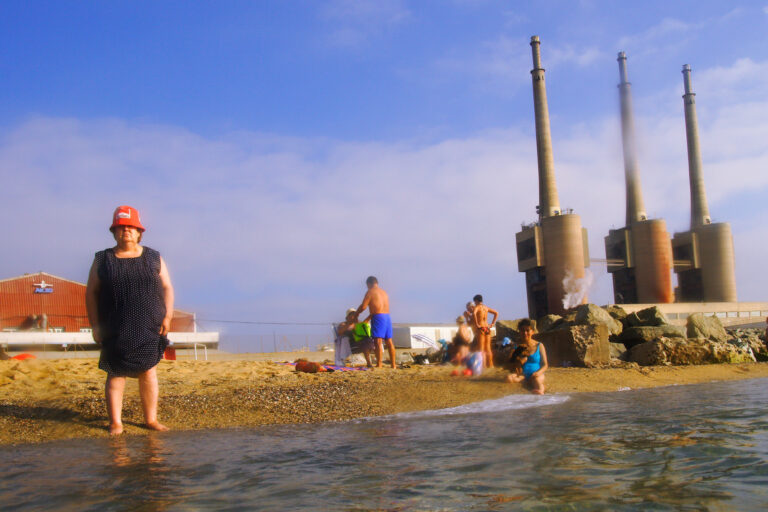
Cartografia Besòs, de Eva Parey
- WhereMUHBA Oliva Artés
- When6 Nov 2026 to 28 Nov 2026
- PriceFree
Overview
Machine translated into English.
Reviews
No reviews yet. Be the first to write one.