Pavelló-Laberint constructs, on the travertine plinth of the Barcelona Pavilion (Ludwig Mies van der Rohe, 1929), a glass labyrinth that revives and unfolds the latent tension of Miesian space, in which transparency materialises, with unsettling precision, the limit without thickness. The surface without mass and the unlimited space constitute themselves as a liminal space-mass.The flat, superficial, exact, conventional, impermeable plane of laminated glass prolongs the condition of the Pavilion as a construction of a non-refuge and intensifies the idea of an architecture that rigorously exposes its fragility. Become Labyrinth, the Pavilion takes the anti-enclosure to the extreme where lightness and transparency become density and opacity.The saturation of the layout of open dividing planes multiplies and fills the experience of the limit until it becomes an absolute, omnipresent and excluding state. The ambiguity between interior and exterior is overcome by the ambiguity between presence and disappearance: the habitable space fades as the presence of space as an object intensifies.Each segment functions as a pause suspended in the continuous air, now completely built and rarefied. It is a geometric inflection that locally disturbs perception while contributing globally to altering the very idea of architectural space, which mutates from void to full, from light to impalpable, from continuous to impenetrable, from universal to inevitable.Pavelló-Laberint implies a strict economy of means that generates an open ecology of ends: a simple and delimited material, in an inscrutable and infinite order. The Miesian plan folds back on itself and vibrates, generating a spectrum of readings that chain transparencies, reflections, transparencies of reflections and reflections of transparencies.The glass reveals a paradoxical condition of wall, which at once exposes and conceals, orients and bewilders, relates and obstructs. Each fold multiplies uncertainty, and the horror of the void as a logical or conceptual dilemma becomes awareness of the full as a concrete tragedy. Instability, fragility and estrangement become order, viscosity and muddle.The regular grid of the travertine plinth, an original prescription, remains as ground, but is reconstituted as the volatile palimpsest of a hieroglyph that speaks an unknown language. The labyrinth functions as a layer that, while not intervening on its substrate, distorts and vitiates its regularity. The labyrinth, literally, interprets the Pavilion, making its silence cry out.Between anti-tectonic precision and anti-critical transformation, and through the extreme intensification of the Miesian canon, the Pavelló-Laberint postulates an architectural form of transparency that, through saturation, transcends the modern illusion of neutrality, homogeneity and generality. And the myth of the void becomes absolute fullness and white noise.
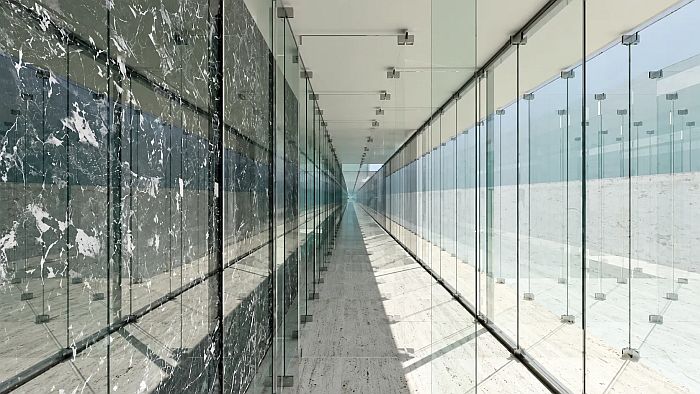
Intervenció artística 'Pavelló-Laberint', de Ciro Najle i Josep Ferrando
- WherePavelló Mies van der RoheAv. de Francesc Ferrer i Guàrdia, 7, Barcelona
- When12 Nov 2026 to 22 Nov 2026
- PriceEntrada general: 9 € · Reduïda: 5 € · Estudiants · Persones en situació d'atur · Targeta Rosa Reduïda · Família monoparental · Família Nombrosa · Grups: 7 € per persona · (mínim 15 persones i amb reserva prèvia obligatòria) · 25 % descompte: · Bus Turístic · Barcelona Card · Barcelona City Tour · Membres de Docomomo Internacional · Arquitectes col·legiats al Col·legi d’Arquitectes de Catalunya · Gratuïta: · Primers diumenges de mes · <16 anys · Targeta Rosa Gratuïta · ICOM · Carnet AMC · Passi Metropolità d’Acompanyant d’un Discapacitat · Professorat docent en centres reglats · Guies turístics professionals i periodistes · Targeta acreditativa de discapacitat de la Generalitat de Catalunya
Overview
Machine translated into English.
Reviews
No reviews yet. Be the first to write one.