The third edition of the Extramurs project will begin within the framework of the opening of the Festival Grec 2026 and will once again count on the stable collaboration of Eina Centre Universitari de Disseny i Art de Barcelona and Centre d'Art La Capella. On this occasion, the artist invited to conceive the city as a space of intervention, mediation and thought will be Dora García (Valladolid, 1965).Extramurs is an initiative of the Museu Tàpies that starts from a multidisciplinary and plural approach, and that is structured around three major conceptual axes: the inter-institutional dialogue, the dialogue with public space and the dialogue with the environment. This approach encourages reflection on contemporary issues and the development of a delocalised and intermittent programme, capable of reformulating the way in which artistic institutions get involved in their urban, social and ecological context.The invitation to Dora García responds to the desire to address these issues from an artistic practice deeply linked to performance, narrative and collective psychology. Her work, focused on the figure of the spectator, the dissident voice and the construction of alternative narratives, offers an opportunity to explore the city as a space of critical thought and social experimentation.Línies de Temps / resurrecció is an artistic project conceived by the artist Dora García that unfolds in a set of interventions, performative actions, collective investigations and film projections that occupy public space, the museum, the city and its symbolic margins. The project proposes a constellation of practices that, although adopting diverse forms, share a common conceptual core: the idea of resurrection as justice, understood not in a religious or metaphysical sense, but as a critical, political and historical tool for thinking about the forms of violence, exclusion and resistance that run through the present.In this sense, the notion of resurrection as justice draws on literary, musical and political sources ranging from Vladimir Mayakovsky to Gal Costa, passing through Sylvia Rivera, Walter Benjamin or Elias Canetti. In all of them, resurrection appears as a radical demand: the need for what was silenced, violated or sacrificed to be able to speak again, to exist and to transform the conditions of the present. The song O Amor, performed by Gal Costa and based on Mayakovsky's poem Amor 3, becomes a key text within the project. Its cry –«Ressuscita'm, encara que només sigui perquè sóc poeta i anhelava el futur»– articulates a vision of resurrection as a historical horizon, as a form of justice that can only arrive when the everyday structures of oppression, misery and sacrifice are dismantled.Dora García conceives this project as an exercise of listening and collective interpellation, where the past is not a closed time, but an active force that returns to question dominant discourses and contemporary power structures. Resurrection, in this framework, is not so much the literal return of the dead as the possibility of symbolically repairing injustices that continue to operate in the present. García invites us to understand resurrection as an active practice: to remember, reactivate, say again and do again what was left interrupted. In this sense, the project does not offer closed answers, but shared spaces of questioning, listening and resistance.
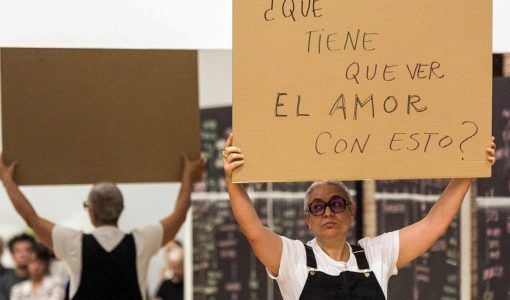
Projecte Extramurs 2026. Dora García
- WhereMuseu TàpiesCarrer d'Aragó 255 08007 Barcelona
- When4 Jul 2026 to 29 Nov 2026
- PriceEntrada general: 12 € · Reduïda:8 € · - estudiants · - majors de 65 anys · - carnet de Biblioteques · Articket: 38 € · Gratuït: · - persones a l'atur · - menors fins als 16 anys · - carnet Amics del Museu Tàpies
Overview
Machine translated into English.
Reviews
No reviews yet. Be the first to write one.