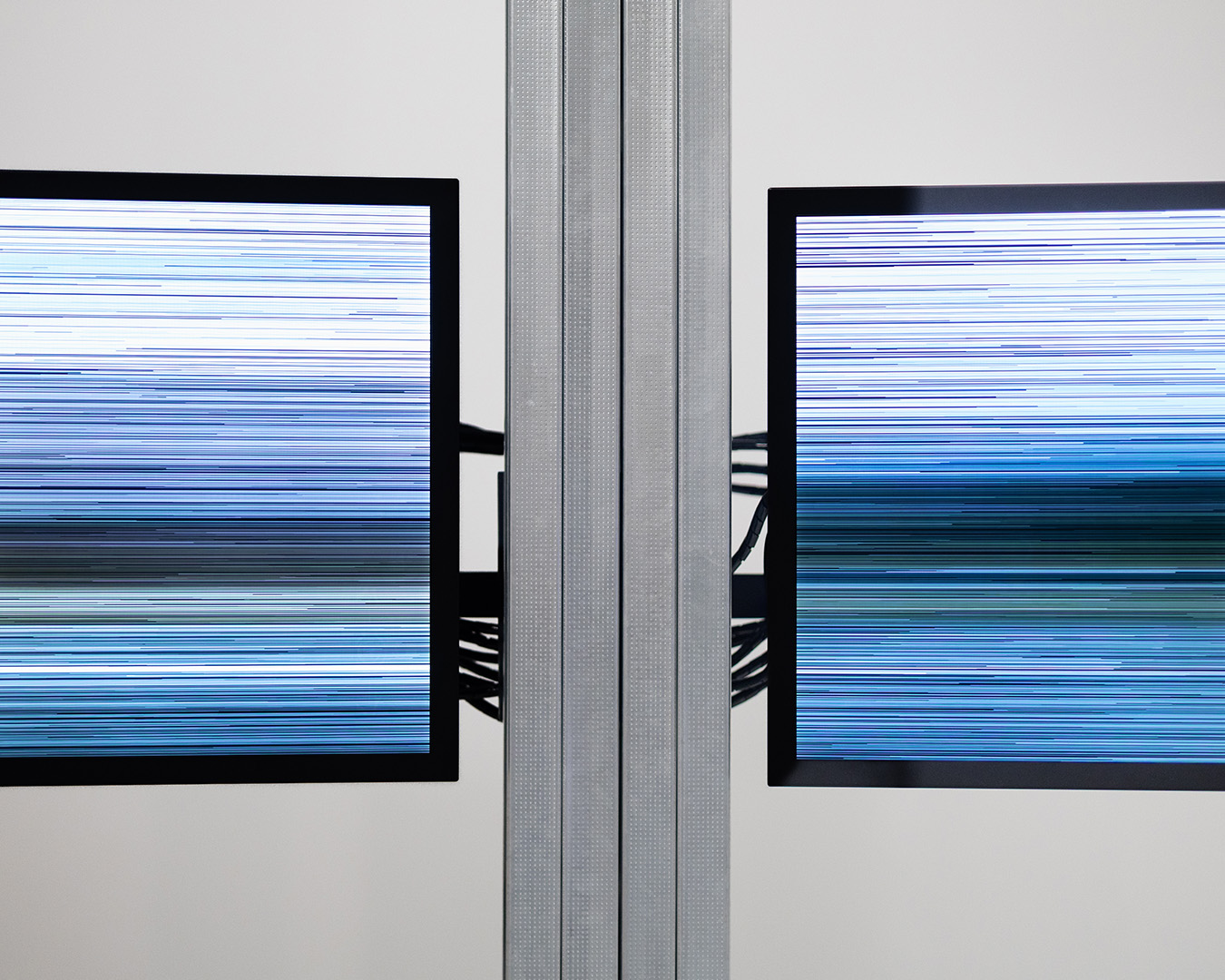
A car travels along a motorway at an average speed of 110 km/h. A train rolls along the tracks at a speed of around 100 km/h. The landscape seen from the window of a train carriage gathers information on roughly 50 typologies of houses, wasteland, trees, buildings and road elements such as traffic signs and guardrails. The carbon dioxide inside a car with the windows closed, driven by at least one person for an hour, is around 1800 ppm, while with three people it can rise to 4560 ppm. In a day, the passage of some 30,000 vehicles can be equivalent to hundreds of 80 kN axles, wearing down the asphalt by an amount barely visible, on the order of a few microns. After six months of heavy traffic, a crack of a few millimetres in a road may require a reconstruction that will be invisible from a car at 110 km/h. It will be a perfect scar. You arrive at work.
You leave work. The road network is made up of a web of lanes that recreate the channels of cells to transmit information in an ultra-efficient way.