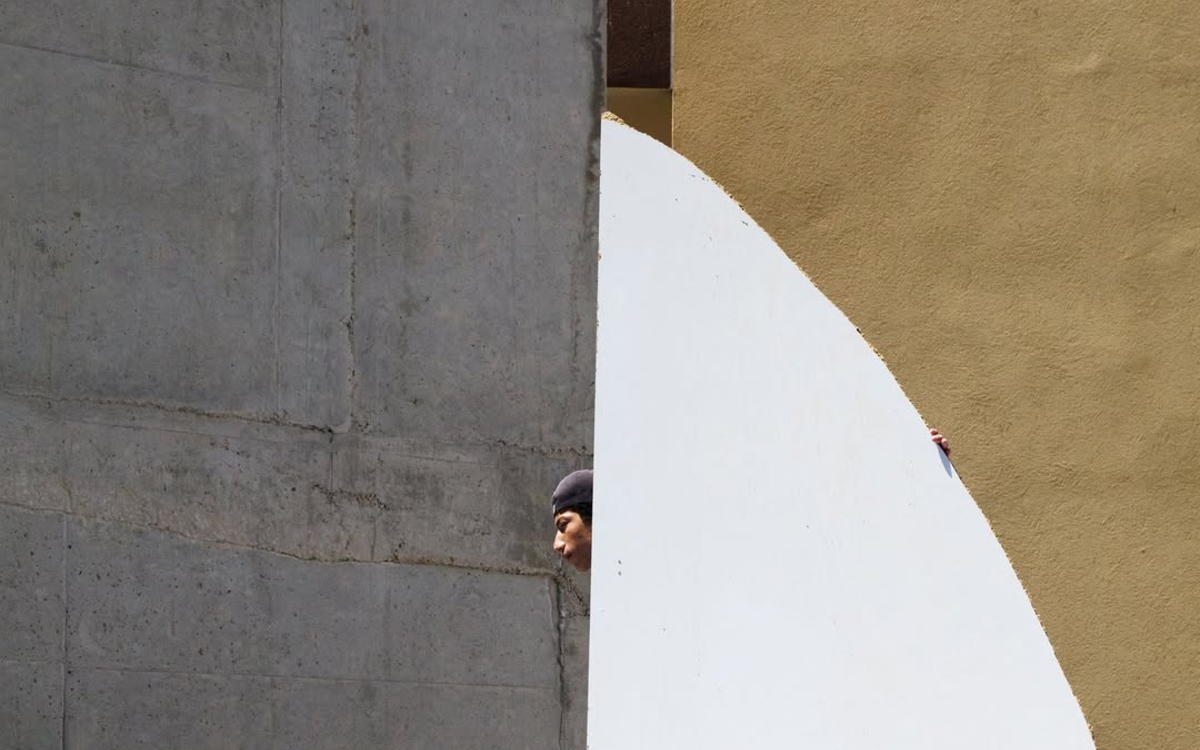
Born in Beirut in 1973, Serge Najjar looks at the city in a way that departs from any expected representation of Lebanon. To look differently is also to refuse to reduce a country to its wounds. Serge Najjar grew up in contact with a family collection kept in Beirut, which brought together works by great masters of abstraction such as Otto Freundlich, Auguste Herbin, Victor Vasarely, Gebran Tarazi, Sonia Delaunay and Aurélie Nemours. He also nourished himself on the exhibition catalogues that piled up at his parents' home.
On these great masters, he says: “They trained my eye. But my approach is above all intuitive. I react to what I see. The connections with art history often appear afterwards. They are the result of influences accumulated since childhood rather than a deliberate will to reproduce a style.”
Trained as a jurist and lawyer, Serge Najjar began a late vocation at the age of thirty-seven and, contrary to the traditional path, moved from the mobile phone to analogue photography. From the school of so-called German objectivism in photography, which he admires, from Bernd and Hilla Becher to Andreas Gursky, he retains the idea that photographic practice can operate in an almost programmatic mode: sober adherence to what has actually been observed, without staging. Serge Najjar's photographs are never retouched.
His rapid fame is intimately linked to social networks. In 2011, he was nominated for the Pictet Prize for a photograph taken with his mobile phone. The enthusiasm aroused by his work was such that the director of Instagram contacted him. He then won the Photomed Prize and published his first book with the support of Jean-Luc Monterosso and Ferrante Ferranti. In 2017, Apple chose one of his photographs for the worldwide advertising campaign for the iPad Pro. He is today followed by more than 130,000 people, and his work is the subject of numerous publications, in every language, including Japanese.
On the walls of construction sites, Serge Najjar searches for images, forms or accidental traces that echo, after the fact, the artists who trained his eye. Naturally, not all of them could appear in the family collection: Kupka, Mondrian, Malevich, Kandinsky or Bridget Riley. He also willingly cites Alexander Rodchenko as a major reference. His gaze is also marked by the compositions of the Swiss school of concrete art, represented notably by Max Bill, Richard Paul Lohse and Verena Loewensberg.
Where photography could allow one to forget traditional pictorial norms in favour of an art of a new kind, Serge Najjar paradoxically brings us back to the history of painting. It is by scrutinising observable reality that he brings forth forms that evoke abstract paintings entirely freed from the representation of nature.
His predilection for concrete, particularly visible in his photographs, might surprise. A poorly loved material, often associated with wild urbanisation and an aesthetic considered a priori reduced, concrete nevertheless offers an extraordinary diversity of possibilities. It allows for curves as well as the boldest angles. Its composition can be transformed, and its surfaces present a great variety of textures and colours: it thus constitutes a true palette.
Concrete is also the material associated with the trio that forms his pantheon of architects: Le Corbusier, Tadao Ando and Oscar Niemeyer. Admiring architects does not mean wanting to photograph their works. In the 1960s, Oscar Niemeyer built the Rachid Karameh International Fair in Tripoli, in northern Lebanon, but Serge Najjar never photographs a finished architecture. When he visits Le Corbusier's Cité Radieuse in Marseille, he does not photograph it any more than the rest.
If he never photographs finished architecture, it is because he seeks to capture the possibility of an image contained in architecture under construction. In a word: create rather than reproduce, even subjectively. His photographs thus bring forth, within ordinary constructions, relationships of lines, planes, colours and proportions that evoke the research of constructed art.
The work of Serge Najjar suggests that what is photographed had perhaps never truly been seen or noticed. It produces in the viewer an illusion, a reversal of meaning, an unveiling. Photography confers on the subject a value it did not seem to possess before being taken.
“Whoever sees my photos sees my thoughts,” said the American photographer Duane Michals. Brassaï, for his part, emphasised to Jean-Claude Gautrand: “The photographer invents nothing. He imagines everything.”
Serge Najjar composes and dismantles space in his mind before releasing the shutter. It is through framing that he eliminates what is foreign to the meaning he wishes to give the image.
In the object he observes, he sees the photograph he is going to take. Facing his lens, the walls, whose irregularities he never conceals, seem to carry living canvases within them.
Serge Najjar, who thinks a great deal in black and white, in shadow and light, nevertheless does not hesitate to capture with his camera flat areas of colour, in the manner of Neo-Plasticism. The colours are not necessarily primary, but they may recall Michel Seuphor's comment on Piet Mondrian, who wrote that Mondrian thus humanised, through colour, his painting or construction projects.
Above all, Serge Najjar makes visible what would have gone unnoticed by the naked eye, what Henri Cartier-Bresson, whom he admires, called “the decisive moment.” When a worker crosses the site, he becomes an integral part of the composition, without having to pose. His photographs thus emphasise the human factor of the working condition, inseparable from the life of a construction site. More than that, the human presence keeps open an essential contradiction: it gives the scale and brings abstraction back toward the real, reminding the viewer that he is looking at a photograph and not a painting.
The photographs gathered here, most of them taken during the summer of 2026, bear witness to a simple conviction: abstraction can be found in reality, provided one knows how to see it: At the instant T.