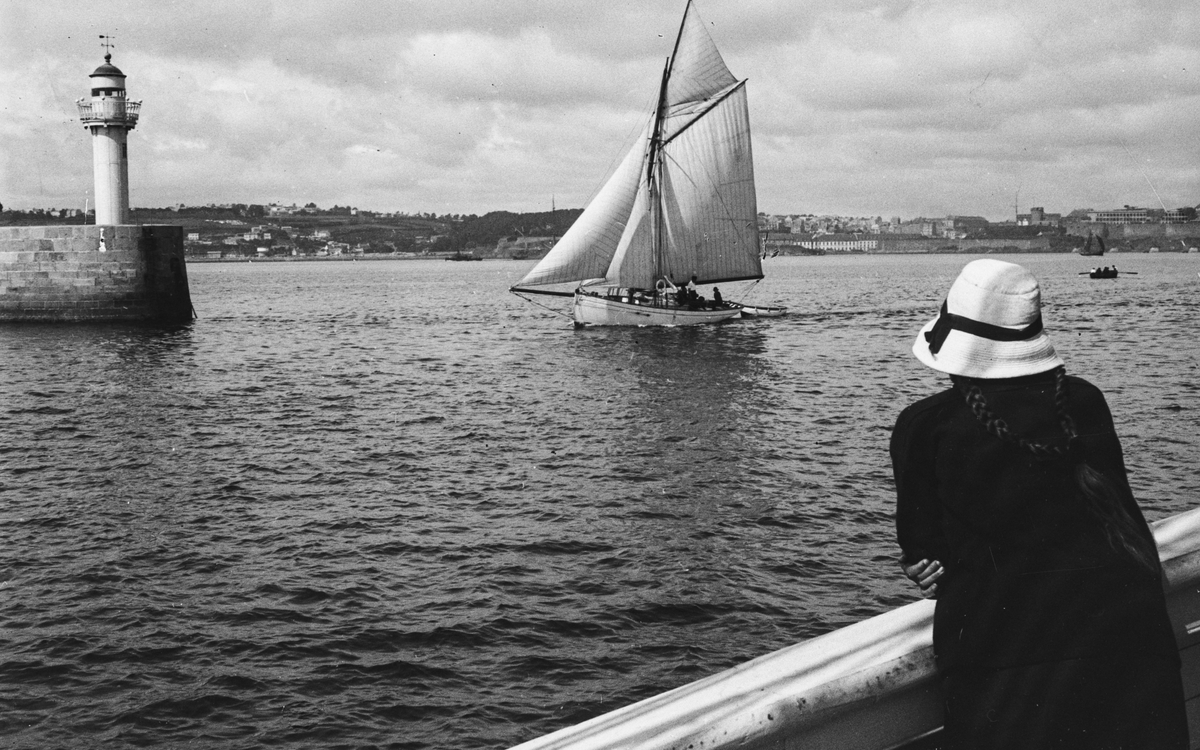
Nicknamed the painter of estuaries and wind, André Dauchez is a landscape painter renowned in France and particularly in Brittany. A versatile artist, he was also an engraver, illustrator, photographer and sailor… Between Paris and Finistère, which he loved so much, painting was his haven of peace. He carved out his own path to happy tranquility at the heart of an era entering a turbulent modernity.
From Paris to Brittany. Born into a family of lawyers and notaries, André Dauchez trained in Paris, first with the engraver Gaston Rodriguez from 1886, then in the studio of the painter Luc-Olivier Merson. In 1890, his sister Jeanne (herself an artist) married the painter Lucien Simon. An artistic complicity was born between the two brothers-in-law. André Dauchez discovered Brittany in 1891 during a family stay. In 1894 his father acquired the Ker Gaït property in Bénodet. This beautiful, spacious residence at the mouth of the Odet became a place of summer and family holidays. Dauchez had his first experiences of sailing with his father. Sailing, regattas, fishing and the still-wild nature fed the eye and temperament of the young Parisian. This encounter with Finistère and its coastline marked him deeply.
In Paris, André Dauchez's studio-apartment was located at 14 rue Saint-Guillaume, in the 7th arrondissement. Following a classic path, he exhibited at the Salon of the Société nationale des Beaux-Arts (1894), of which he would become a member and later president. In 1898 he married Marie-Thérèse Le Liepvre at the church of Notre-Dame-des-Champs, in Montparnasse. Eight children would be born of their union. In 1900, André Dauchez was one of the founding members of the Société nouvelle de peintres et de sculpteurs. He then regularly exhibited his canvases at the famous Galerie Georges Petit. In the Paris of the Belle Époque, artistic effervescence was palpable. The wind of Impressionism and the practice of plein air painting brought a new and liberating breath. André Dauchez carried both of these legacies: that of his academic training and that of Impressionism. Yet Lucien Simon and André Dauchez would distance themselves from post-Impressionism. Within the circle of the "Bande noire", under the impetus of Charles Cottet, this small group of friends linked to Brittany and the world of the sea stood out for its use of a dark palette. In the line of Courbet, banishing idealized subjects, the "Bande noire" claimed a realist painting, showing all the darkness and hardships of everyday life.
In 1903, André Dauchez bought land at Loctudy, in southern Finistère. He had his studio-house built on the dune of La Palud du Cosquer. This land of Armor, shared between sky and sea, runs through his work. Also passionate about sailing, Dauchez owned five boats: the Sprat, the Aventure, the Rose des Vents, the Embellie and the Grande Ourse. In 1928 he illustrated (among others) André Chevrillon's book La mer dans les bois, with 77 etchings. In the capital, Dauchez became a recognized painter; his submissions to various salons, in France but also in Europe and America, earned him numerous honorary distinctions: he was awarded a silver medal at the Exposition universelle in Paris (1900); Knight of the Legion of Honour (1911); painter of the Navy (1922); president of the Société nationale des Beaux-Arts (1931); Officer of the Legion of Honour (1932) …
"Par les champs et par les grèves…"
From Rennes to Douarnenez, André Dauchez painted a preserved and dreamed-of Brittany. His work, sensitive and rigorous, is endowed with a sense of nature. It unites sky, sea and land. His painting is breath; it tells the story of wind and light. Dauchez takes us aboard a boat that descends the river to the sea, from darkness to clarity. Tall pines rise and elegantly adorn the sky. Banks and shores: André Dauchez paints the edge of the world, the coastal and the familiar. His landscapes, vast and deep, are at once calm and turbulent. Between order and freedom, the water flows like passing time.