Born in 1954 in Quetta, Pakistan, to Australian parents, GW Bot is an Australian artist whose work explores the connections between the human being, the landscape and the inner world. Her childhood spent in several countries nurtured from an early age her interest in cultures and territories. She studied art in London, Paris and Australia, and in 1982 obtained her diploma from the Australian National University in Canberra. Since 1985, she has devoted herself fully to her artistic practice. Settled in Canberra, at the heart of an environment that becomes the major source of her inspiration, she adopts the wombat as her totem animal, referring to the relationship of unity between the human being and their environment present in certain Aboriginal traditions. She forged her artist name from one of the earliest written designations of the wombat in a French source: "le Grand Wam Bot".
Foreword to the exhibition
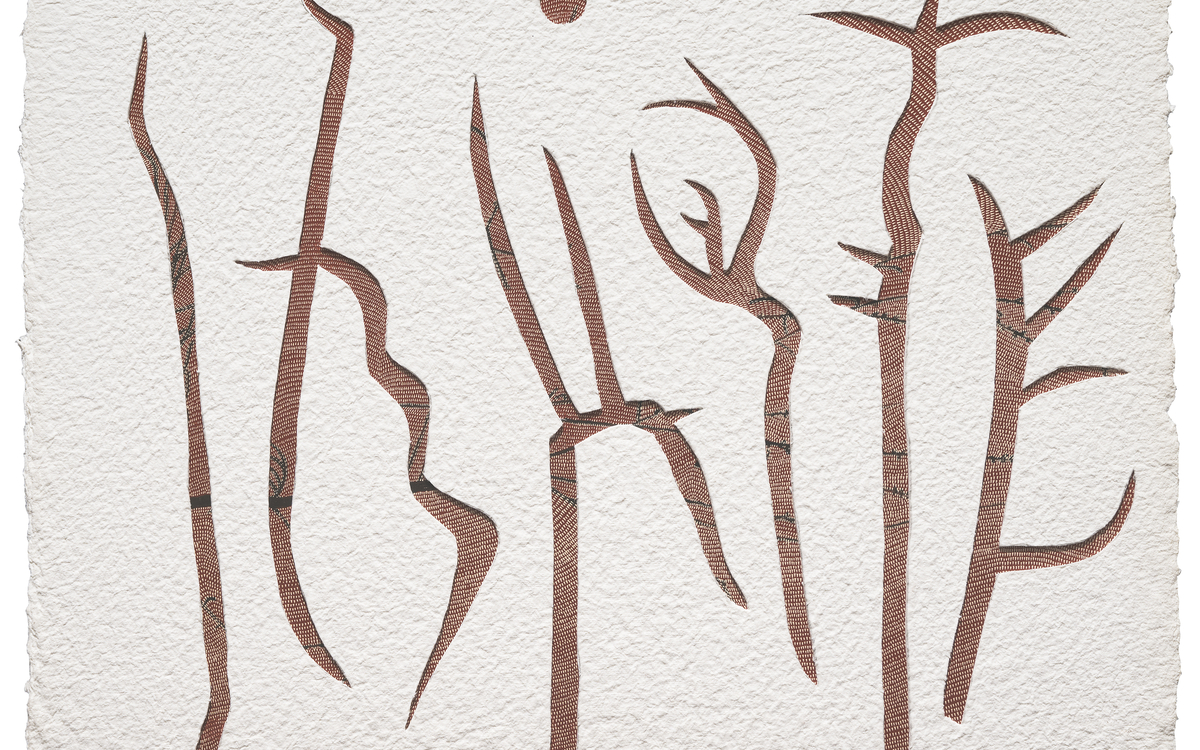
Through her works, GW Bot develops a singular visual language based on "glyphs", signs that she invents and transforms in contact with Australian landscapes. A glyph is a graphic sign that carries within it a form and a meaning. Halfway between plant, animal and human forms, these signs constitute an open alphabet, whose meaning deliberately remains mysterious.
The artist does not seek to represent nature realistically. Rather, she translates its rhythms, forces and transformations. Forests, meadows, cliffs, burnt lands or arid landscapes thus become the sources of a personal writing.
Her universe has also been built over many journeys in Europe and the Middle East. Byzantine art, the sculptures of Aghtamar, the motifs of oriental carpets, or even The Lady and the Unicorn have nourished her imagination and enriched her vocabulary of forms and symbols. Literature and poetry, notably the work of Alexander Pushkin, also accompany her reflection on creation and on the figure of the poet.
Little by little, her work has turned towards the theme of the garden. This becomes a space both outer and inner, where nature, the intimate and spirituality meet. Drawing in particular on the tradition of the hortus conclusus and religious representations, GW Bot makes the garden a place of contemplation and passage between the visible and the invisible. This attention to the garden may, in some respects, evoke that of Bonnard, for whom this space also becomes a sensitive and pictorial territory.
All these influences blend in a body of work deeply rooted in Australian territory and attentive to its fragility. Fire, drought, disappearance and rebirth become expressions of the cycles that run through the living world.
The "black sun", a recurring motif in her work, introduces a dimension that is both cosmic and symbolic. It evokes the relationships between darkness and light, disappearance and rebirth, and accompanies the idea of transformation.
Linocut, pigments, graphite, cut-outs and tapa take part in this visual writing made of imprints, superimpositions and transparencies. The choice of paper also occupies an essential place in her creative process. GW Bot considers it a true "ground": its texture, its density and its capacity to receive the image directly influence the result. Each paper thus possesses its own qualities and, like a ground, can welcome certain forms and transform others.
GW Bot's work thus composes a true poetic cartography, in which landscape, memory, spirituality and language meet and endlessly transform one another.