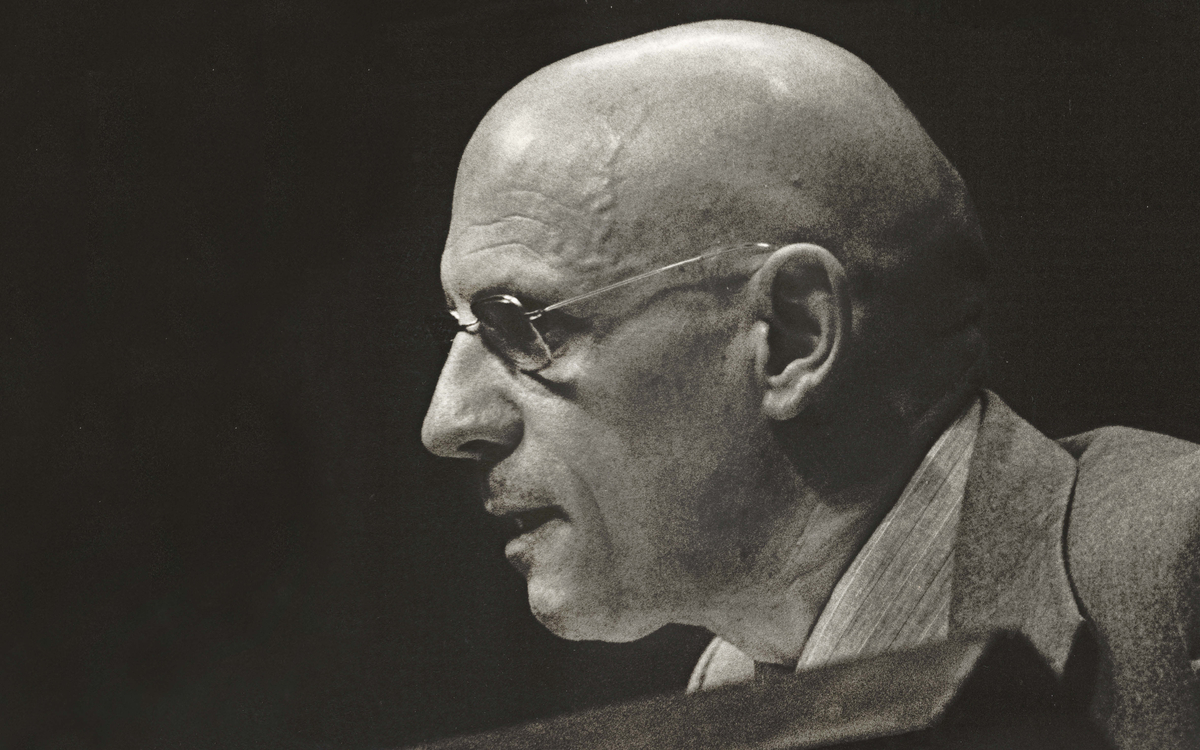
On 12 April 1970, the philosopher Michel Foucault, an author as celebrated as he is debated for Histoire de la folie à l'âge classique and Les Mots et les Choses, was elected to the Collège de France to the chair of the History of Systems of Thought. This election was far from obvious for a researcher who had first taught psychology but refused disciplinary allegiances, and whose career was already marked by controversies and strong political commitments. It inaugurated an intellectual adventure of nearly fourteen years whose resonances can still be heard today, as attested by the fertility of the concepts of "governmentality", "biopolitics", "pastoral power" or "regime of truth".
His courses at the Collège de France are far more than a sketch of the written work. They allowed him to explore new fields and test new hypotheses. Their influence began very early with public success and the free circulation of recordings and typescripts. It quickly went beyond the borders of France, thanks to an international audience and the philosopher's numerous stays abroad, notably in the United States, Brazil and Japan. The posthumous publication of the courses, then their translations around the world, make them a work in its own right, as widely read and cited as the books published during his lifetime. They thus gave his thought an unexpected second life, so much did they renew the perception of its stakes and shed light on his method.
The hundred or so pieces on display – unpublished manuscripts, personal objects, audio and video archives – trace a dazzling international trajectory, cut short too early, leaving a considerable scientific output. The exhibition notably sheds light on the coherence and enduring relevance of a thought in constant evolution that refused categorisation. It places this adventure within a network of friendships and peers at the Collège de France, but also within strategies and struggles beyond its walls, which remind us that knowledge is also a matter of power.
An exhibition organised by the Collège de France in partnership with the Bibliothèque nationale de France.