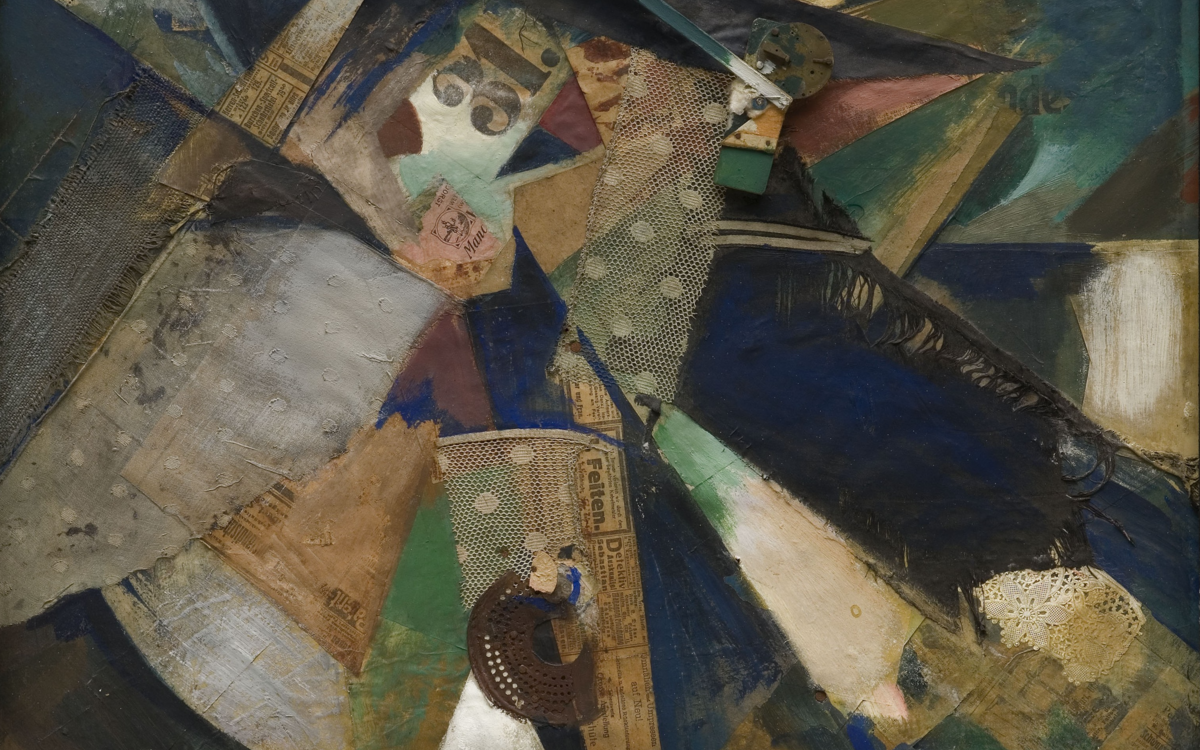
The work of German artist Kurt Schwitters (1887-1948) charts a singular path within the art of the first half of the 20th century, founded on the collective experience of war's destruction and the iconoclastic, plastic reinvention specific to the radical German scene of the 1920s and 1930s.
Painter, assembler, poet, musician, sculptor, typographer, editor of a magazine and event organiser, this anarchist "one-man orchestra" artist, whose work merges with his life, defies categories and appears irreducible to any attempt at classification. Schwitters, initiating unprecedented collaborations with Dada and the Constructivists, formulating his own movement Merz, counts among the essential figures of geometric abstraction, taking part in several historic exhibitions in Paris in the interwar context.
He is one of those creators who, like his contemporary Pablo Picasso or other figures of the Dada constellation, radically redefined the boundaries of art. He conceives his works from castoffs and debris transformed into "harmonious" material, and develops an Kurt Schwitters beim Vortrag der Ursonate, London, 1944, Merzbau, Kurt Schwitters organic architecture of angles and hollows within his own house, the Merzbau.