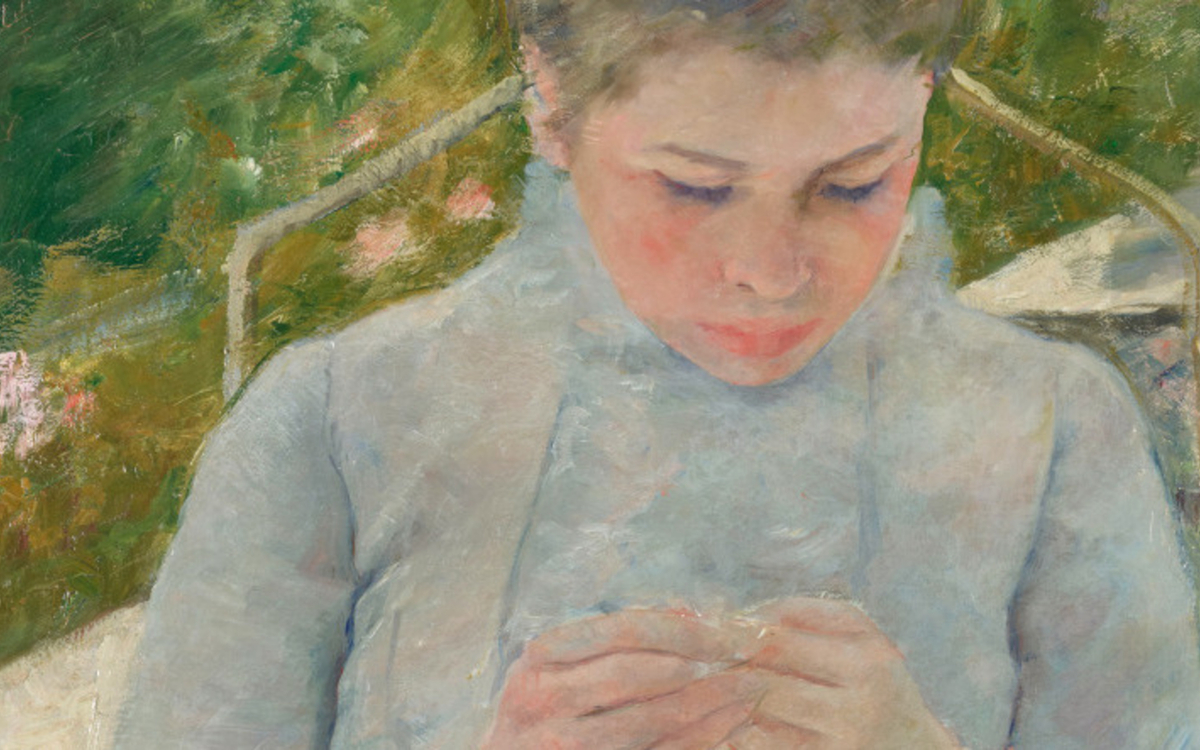
Mary Cassatt described herself as "American, clearly and frankly American", but she first anchored her art in the pictorial tradition of the old masters, studied during her travels in Europe, before becoming a key figure of the Impressionist movement in France, where she lived for no less than six decades. "I am independent!" she proclaimed: "I can live alone and I like to work". Taking a chrono-thematic approach, the exhibition offers a new portrait of the artist, studying her art through the lens of the notion of independence, of which she was very proud, and which she made the guiding principle of her whole life.
Comprising nearly 80 paintings, pastels and prints, and covering the artist's entire career, "Mary Cassatt, L'indépendante" opens up new perspectives on her work, drawing on unpublished letters and sources not yet exploited to date. Works from European public and private collections, rarely shown, will be presented, as well as paintings and pastels from American collections seldom exhibited outside the United States.
A selection of Cassatt's early works and portraits of her close circle shows how the artist's social background, her travels and her knowledge of the art of the past shaped her approach and practice. Making a point of being independent (originally, at the request of her wealthy family), she quickly set up her own studio and employed paid models. In a largely male environment, and against a backdrop of latent nationalism, she soon succeeded in establishing herself as a professional painter.
Her depictions of elegant young women, moving in society, receiving guests at home or enjoying themselves at the theatre – conquering the modern world, and their independence – are among the artist's most remarkable achievements, as dazzling examples attest. These bold and lively images never failed to attract attention at the Impressionist exhibitions in which Mary Cassatt took part assiduously (four times, starting in 1879), at the invitation of her friend Edgar Degas. Mary Cassatt's essential contribution to these avant-garde exhibitions, self-proclaimed "independent", will be examined and reassessed.
Her activities in the art market constitute another fundamental aspect of the artist's independence. She specialised in painting "mothers and children", a genre in high demand, in which she excelled – and with which she remains associated – while also fulfilling portrait commissions. A few key works in the exhibition will also evoke her crucial role as "consultant", advising her American relatives, friends and acquaintances in their purchases of paintings, notably Impressionist ones – and thus in the building of art collections in the United States.
At this stage of her career, in the early 1890s, Mary Cassatt's financial independence allowed her to become a landowner. Surrounded by a vast park, the château she acquired in the Oise serves as a backdrop for many outdoor scenes featuring women and children: luminous works with vibrant colours. Modern Woman, the most important commission the artist ever received, for a monumental decoration intended for the Woman's Building at the 1893 World's Columbian Exposition in Chicago, constitutes a highlight of her career and a major milestone in her oeuvre. This colossal decoration, now lost, will be evoked within the exhibition route through a group of prints and pastels related to this decoration, as well as through a film presenting a digital restoration of this gigantic work (4 x 18m), of unique ambition both in its dimensions and its subject. Her admirable series of prints, the Dix Planches en couleurs, will also be studied in light of this new, remarkably experimental phase of her work, and of her progressive views on the education of women.
Mary Cassatt's commitment to independence indeed went beyond her own career and artistic approach. A fervent supporter of women's struggle for the right to vote, Cassatt encouraged her contemporaries to "work for suffrage, for it is women who will decide the question of life or death of a nation." With her friend Louisine Havemeyer, she organised in 1915, in New York, an exhibition in support of women's suffrage. A small selection of Mary Cassatt paintings shown in this exhibition concludes the route, demonstrating how not only the art of this pioneering artist, but also her actions, could tend towards activism.