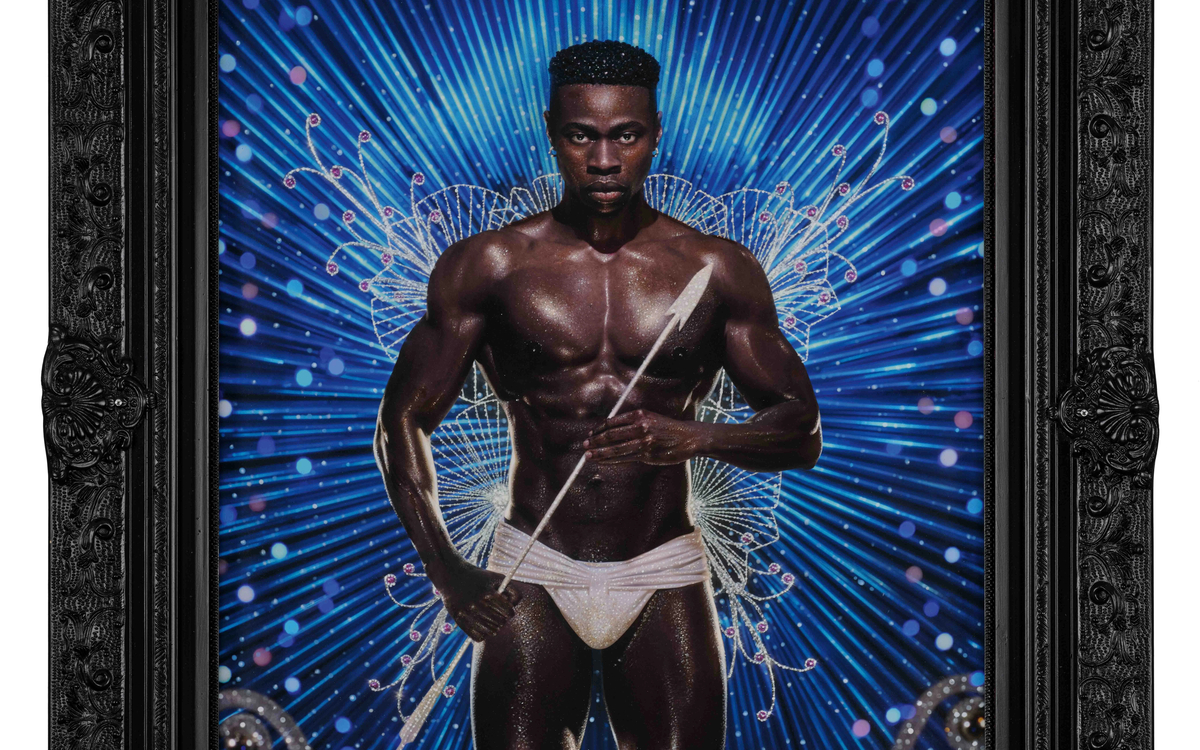
Met in 1976, photographer Pierre Commoy and painter Gilles Blanchard form a couple in life as in art. They very quickly invented a common artistic language, unique of its kind: photography and painting merge on a single canvas, creating symbolic and idealized portraits. This painting gesture, which gives the images brilliance and saturated colours in the manner of the very first photographic retouches, where colour was applied by hand, makes each portrait a unique piece. Each work is born from a long staging; sets, costumes, accessories and lighting are designed and made by hand in the artists' studio in the Paris region. The studio thus becomes a theatre where the set carries the story of its model, sometimes famous, often anonymous or close to the artists, but always sublimated.
With "rose pour toi, rose pour moi", Pierre et Gilles continue their exploration of the making of contemporary icons. Sacred figures, stars, pop creatures, fictional characters or close friends of the artists meet in a universe where the real tips over into dream.
"The aim of Pierre et Gilles is not to impose a narrow vision of things, but to question society from the fantasies that circulate within it. Their work is grounded in reality, but approaches it through dream, of which Freud said that it proceeds by condensation and displacement – photography, with them, becomes a psychic process [1]."
Stylists, DJs, actors, drag queens, models and friends of the artists rub shoulders with figures of sacred iconography, marine imagery, dreamlike visions and the baroque. The exhibition makes visible the full extent of their universe, from popular devotion to pop culture, where the public can discover unreleased works such as Lady Macbeth (Camille Cottin) , 2026, Maria Magdalena (Lolly Wish) , 2026, L'Étoile noire (Ebony Osaz) , 2026, Saint Carlo Acutis (Martin Tournebize) , 2026 or even Vive moi – Hommage à Renaud (Renan Prevot) , 2025.
The monograph published by INSIGHT editions brings together for the first time the works of Pierre et Gilles according to a thematic classification. Introduced by a text by Laura-Ève Lambert, each set is enriched with writings by personalities such as Edouard Louis, Sylvie Vartan, or even Amanda Lear, as well as anecdotes from those who have passed before their lens.