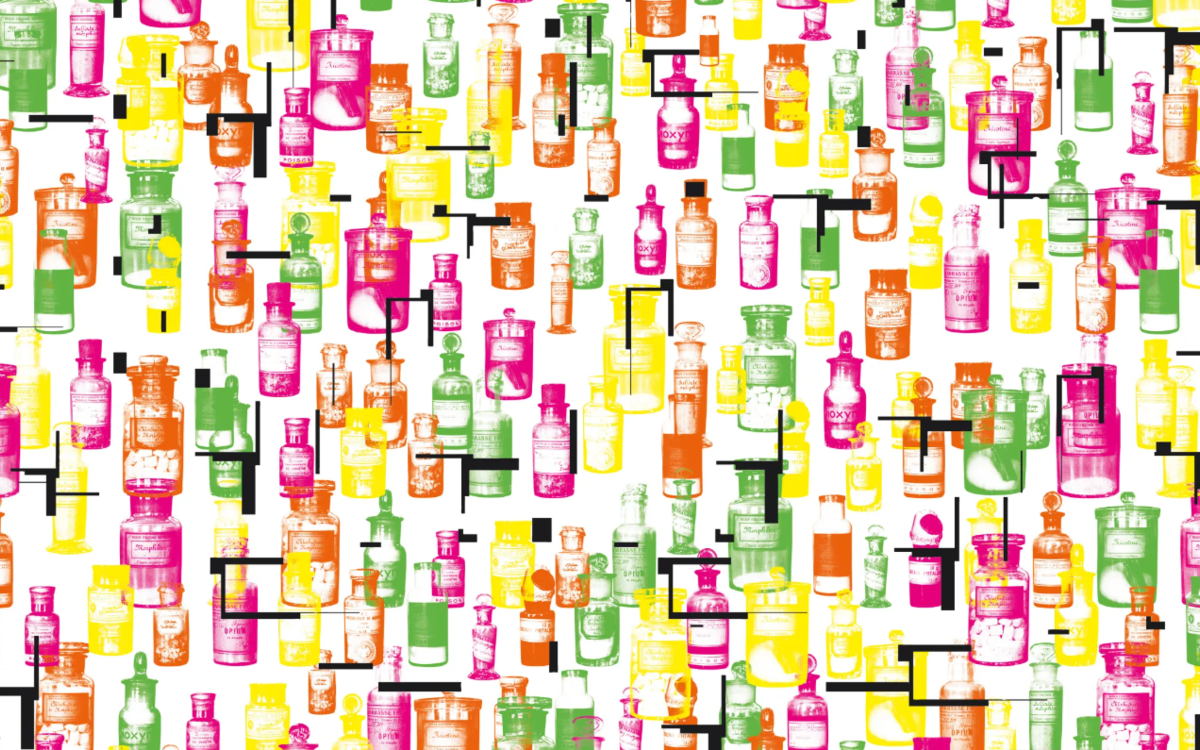
Through an original and dynamic scenography, the route invites critical reflection on drug consumption and the dangers of drugs. Across a surface area of 650 m², you will be able to discover a multitude of displays, collection objects, archives, testimonies, and artistic creations from past and present…
Deconstructing the word « drogues »
By beginning with a presentation of a wide diversity of products, whether licit or illicit, natural or synthesised, the exhibition deconstructs the term « drogues » (drugs) in favour of the term psychoactive substances. From narcotics to products consumed every day, such as tobacco, tea or coffee, these substances all have one thing in common: they act on the central nervous system and the psyche. Their classification as licit or illicit varies according to products, eras, societies, beliefs… You may be surprised to learn that our species is not the only one to consume them, or that the first traces of consumption date back to prehistory!
Social, health… and environmental issues
Starting from the observation that most human societies consume psychoactive substances, the exhibition examines their function. You will pass through different contexts of use and discover varied modes of consumption at the level of groups or individuals: therapeutic experimentation, the need for social conformity, self-transcendence and optimisation of intellectual, sporting or military performance, hedonism, access to mystical worlds, or artistic inspiration…
From producer to consumer, the exhibition traces the circuits of psychoactive substances to highlight the effects of growing production on environments and societies, address issues linked to their circulation across the world, and show the different marketing strategies used by sellers of legal as well as illegal products.
Finally, the public policies put in place to respond to the social and health issues linked to the consumption of psychoactive products may be more or less repressive, more or less tolerant, depending on the values and priorities of different States. With what effectiveness? The exhibition questions the notion of « risks » linked to taking substances, and looks back at the history of harm reduction policy in Europe from the 1980s onward.
Rooted in a humanist perspective, it concludes with an installation that gives voice to consumers of psychoactive substances. In this way, you will discover varied profiles, far from the stereotyped image of these users.
Scientific curatorship
François Beck, sociologist, researcher at the Centre de Recherche en Épidémiologie et Santé des Populations (CESP) of Inserm, former director of the Observatoire français des Drogues et Toxicomanies (OFDT);
Vincent Verroust, ethnobiologist, researcher in psychedelic studies at Cermes3 – Centre de recherche médecine, science, santé et société, Inserm;
Alain Epelboin, medical anthropologist, honorary attaché at the Muséum national d'Histoire Naturelle, former member of the Scientific College of the Observatoire français des Drogues et Toxicomanies and of the scientific council of the Mission interministérielle de lutte contre les toxicomanies (MILDT).
Museographic curatorship
Marie Merlin, museographer and exhibition project manager
Charlène Camarella, museographer and exhibition project manager.