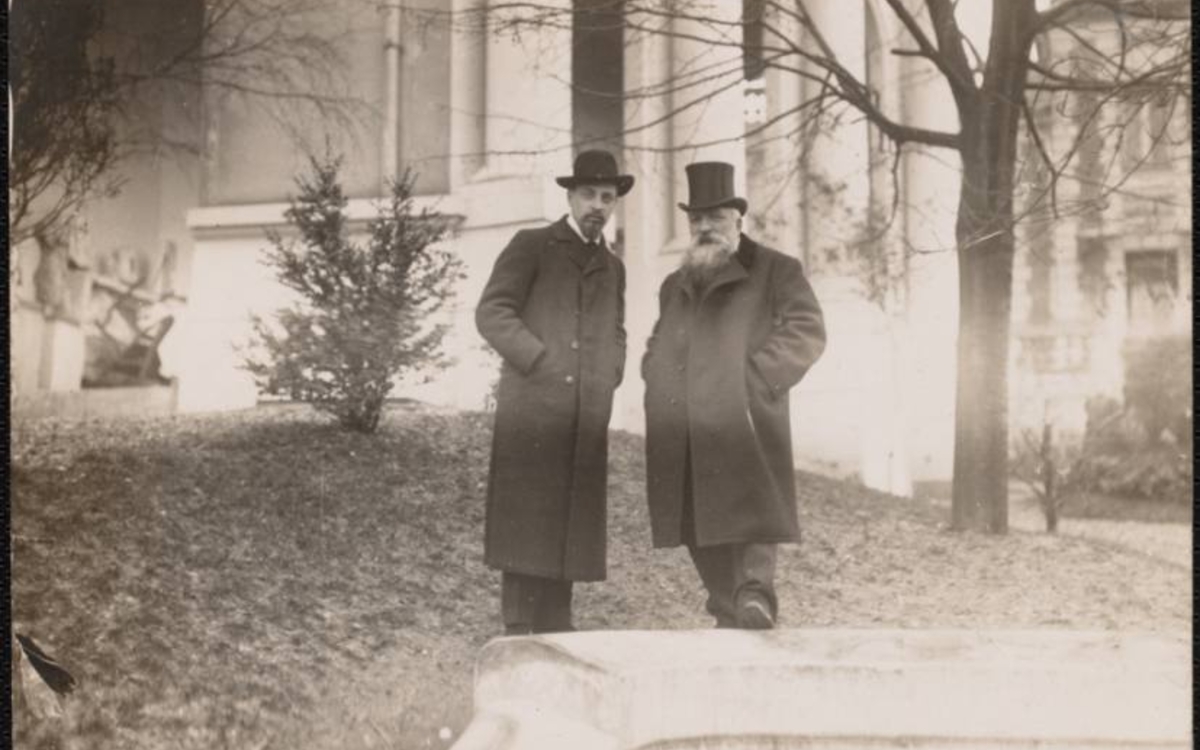
The exhibition invites visitors to take a fresh look at Rodin's work through the words of the man who was in turn his admirer, his secretary and his disciple.
A decisive encounter between two artists
In 1902, Rainer Maria Rilke, a young German-language poet still little known, was commissioned to write a monograph devoted to Auguste Rodin, who was then at the height of his fame. This meeting marked the beginning of an exceptional relationship that would last for nearly ten years.
Fascinated by the artist and his work, Rilke immersed himself in the sculptor's world, from the Villa des Brillants in Meudon to the Hôtel Biron in Paris. Over the course of their exchanges, their collaborations and sometimes their misunderstandings, a relationship built on admiration and artistic rivalry took shape. In contact with Rodin, Rilke learned to look differently, to observe forms and to grasp the essence of things. This experience profoundly transformed his writing, while his texts offer a unique insight into the sculptor's work and creative process.
A poetic journey into the heart of Rodin's work
Across six thematic sections, the exhibition traces this fruitful relationship and offers the chance to rediscover Rodin's masterpieces in the light of Rilke's writings. Sculptures, drawings and photographs engage in dialogue with the poet's texts, while manuscripts, books and archival documents bear witness to the richness of their exchanges.
From "Formes indolentes qui attendent" to "Les mains ont une histoire", the itinerary explores the themes that run through their works: the body, movement, the face, the creative gesture and the expressive power of matter. The poet's words accompany the visitor's gaze, revealing another way of apprehending the sculptures, their presence and their inner life.
The exhibition concludes with the famous injunction "Tu dois changer ta vie", which resonates as the legacy of this decisive encounter. "Rodin selon Rilke" thus invites us to discover how, beyond their respective disciplines, two artists nourished each other's vision of art and renewed their ways of creating.