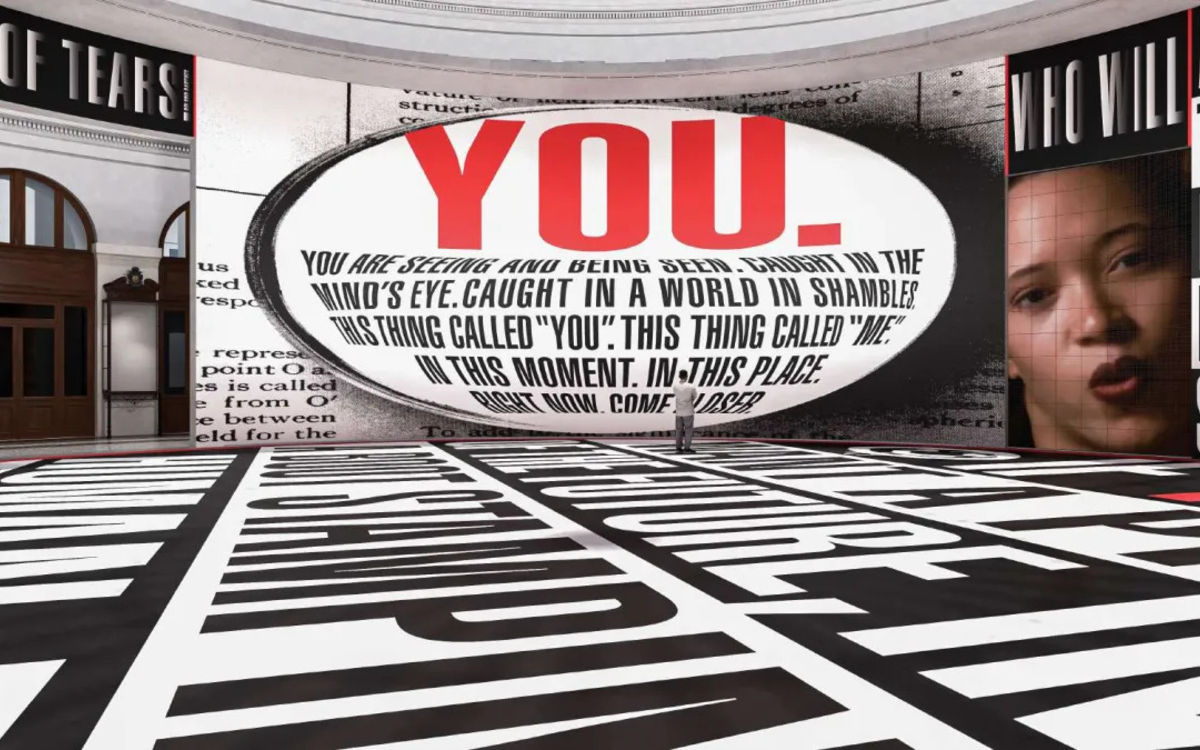
Designed specifically for the museum's Rotunda and display cases, the exhibition "The History of Tears" ("L’histoire des larmes", in French) by Barbara Kruger confronts visitors with an uninterrupted flow of words, phrases and injunctions, filmed sequences and voices.
At the heart of the museum, the curved walls by Tadao Ando become the support for monumental quotations borrowed notably from the literary works 1984 (1949) by George Orwell and Cahier d’un retour au pays natal (1947) by Aimé Césaire, while the twenty-four display cases of the Passage, transformed into light boxes, punctuate the space with dazzling injunctions written by Barbara Kruger (born 1945).
Two videos, reinstalled today in this new arrangement, are also woven into this ensemble. Made and edited by the artist at the Wexner Center for the Arts in Columbus (United States), Power, Pleasure, Desire, Disgust was first presented in 1996 before being shown several times in different contexts, always linked to a textual environment. The works confront the visitor with a succession of faces, gazes and words in which desire, domination, fear and violence intermingle. Between verbal saturation and visual immersion, Barbara Kruger creates a total work in which the intimate and the political, the body and language, collide in a hypnotic whirlwind whose significance resonates today with striking acuity.
« An endless deluge of eyes. A fountain of loss and fear. But also of power, pleasure, desire and disgust. A reservoir that fills through domination and conquest, on a global scale as well as a domestic one. A fountain that gushes in moments of great violence and brutality, but also at the heart of the most intimate cruelties. It can be triumphalist in its scale, or drizzle, like a petty melodrama studded with caricatures of seduction and grotesque rejection. It is a bodily production both remembered and forgotten. It is a body in tears, lost amid the rubble of battles fought over money, land, love and other bodies. Mapping this emotional fountain, placing it within its historical context, leads to speaking of the profound struggle between the powerful and the powerless, the loved and the unloved, the winners and the losers. It reveals shame, pride, conviction and doubt in an intensely menacing and tragically comic way. It can show us and tell us how we were, how we are and how we will be toward one another. »
— Barbara Kruger,
about « The History of Tears ».
Curator: Matthieu Humery, photography adviser to the Collection Pinault, with the collaboration of Lola Regard, project manager.