Exhibition project curated by Francesco Sacco, inspired by a poem by Vladimir Nabokov A discover.
The exhibition project is inspired by a poem by Vladimir Nabokov, A Discovery, first published in The New Yorker on 15 May 1943.
Nabokov (1899–1977), a Russian writer who became a naturalised American, is considered one of the great narrators of the 20th century. Made famous by the novel Lolita, he was also a gifted entomologist who, from childhood and throughout his life, devoted himself passionately to the study of the taxonomy of Lepidoptera, so much so that between 1942 and 1948 he was curator of the lepidopteran collections at the Museum of Comparative Zoology of Harvard University.
Written on the occasion of the discovery of a new species of butterfly - "I discovered it and gave it a name, [Neonympha dorothea] / in Latin taxonomic form, thus I became / godfather of an insect and its first describer, / and I desire no other fame." - the poem celebrates the scientific immortality of that specimen, marked with the red label that identifies it as Type: "Dark paintings, thrones, the stones that pilgrims kiss, / poems that take thousands of years to die, / barely mimic the immortality of this / red label on a small butterfly".
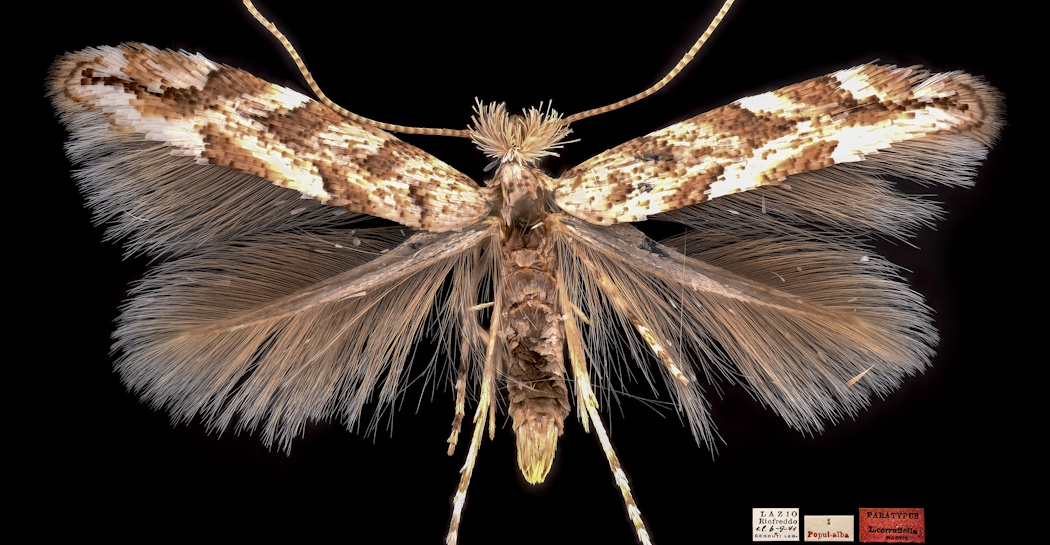
The exhibition route opens with three educational panels - red labels, Linnaean nomenclature, the species richness of the planet - which introduce the specimens marked with the red label, displayed in a showcase within an entomological box: unique and immortal, according to Nabokov. These are followed by 16 entomological photographs, in high definition and at 100 × 70 cm format, taken by the author, with captions giving the scientific name, place of capture, conserving institution, photographic technique and magnification, as well as copies of the original descriptions.
The large central showcase displays copies of Nabokov's literary works published in Italian, and two important volumes on his entomological work.
The exhibition will be accompanied by Il dèmone di Vladimir Nabokov, a film with readings by Fabio Traversa, filmed and edited by Jan Stöckel.