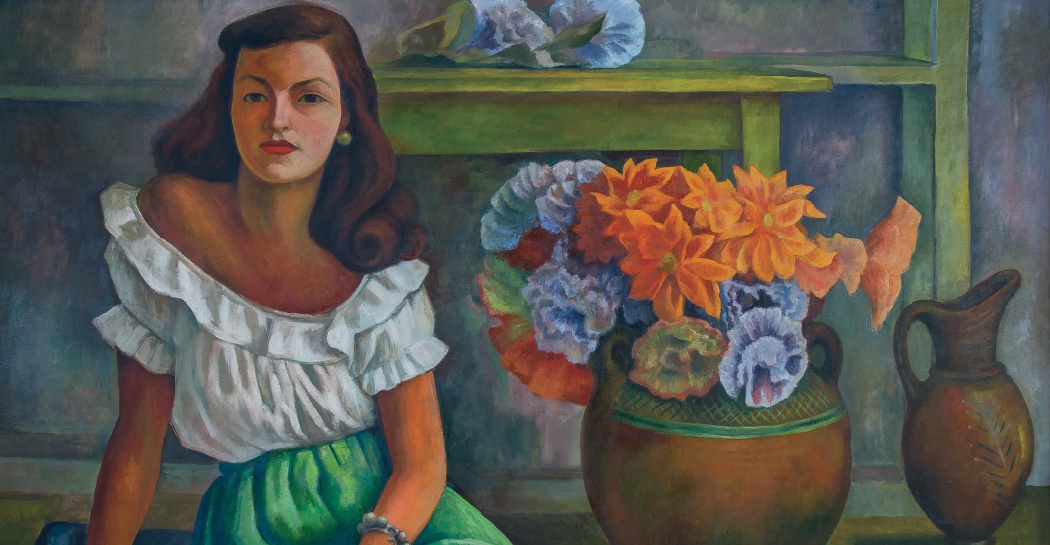
The exhibition is the largest exhibition on Mexican art in Europe in recent decades, the first held in Italy on Diego Rivera.
Visit the page > Accessibility of the exhibition Diego Rivera e la costruzione dell’arte moderna in Messico nel XX secolo
A journey through the colors of Mexico in the splendid setting of the Musei Capitolini – Villa Caffarelli, an intense retrospective dedicated to the celebrated Mexican painter and muralist, whose work forms a hinge between tradition and the future, capable of giving life to an autonomous and distinctive visual language of modern Mexican art.
Alongside the works of Diego Rivera, the exhibition presents masterpieces by extraordinary artists such as Frida Kahlo, José María Velasco, José Clemente Orozco, David Alfaro Siqueiros, María Izquierdo, Tamayo, Lozano, Montenegro, Ruiz, Dr. Atl, Saturnino Herrán and many others. Some evocative videos and photographs enrich the route, including photographs of Rivera, immortalized by Tina Modotti.
A group of artists who were able to интertwine tradition, avant-garde and a plurality of aesthetic languages. The exhibition route thus allows one to retrace the genealogies of Mexican modernity, placing the figure of Rivera at the center of a visual and conceptual fabric in which academic training dialogues with experimentation and with a deep attention to the social present.
Through an extraordinary selection of over 140 works, thirty of which are by Diego Rivera, the exhibition route conveys the complexity of a process whose roots lie in the birth of independent Mexico in 1821, when the need for a cultural identity capable of representing a new, heterogeneous and constantly changing country asserts itself. In this context, art becomes a privileged tool for visually constructing the face of Mexico, as well as a vehicle for projects of cultural transformation that combine tradition and modernity and project onto the international stage a plural and constantly evolving image.
During the first half of the twentieth century, Mexican art redefines itself through the creation of a language and iconography of a national character. Artistic practice turns its gaze toward the fusion of pre-Columbian heritage, popular cultures and social concerns emerging from the post-revolutionary period. In this framework, the visual arts play a decisive role in the reconstruction of the country's social fabric, finding in the muralist movement one of the most influential projects on both the national and international level. Promoted in 1921 by José Vasconcelos and consolidated by the artists José Clemente Orozco, David Alfaro Siqueiros and Diego Rivera, Muralism contributes to democratizing art and to building an epic narrative of Mexican history, in which the people, workers and peasants become central protagonists. The result is a new national iconography that speaks to communities and public spaces and redesigns the social role of the artist.
The exhibition route is organized into four thematic sections:
Each section brings together emblematic works between the nineteenth and twentieth centuries, accompanied by critical contributions from authoritative art historians collected in the exhibition catalogue, published by Gangemi Editore.