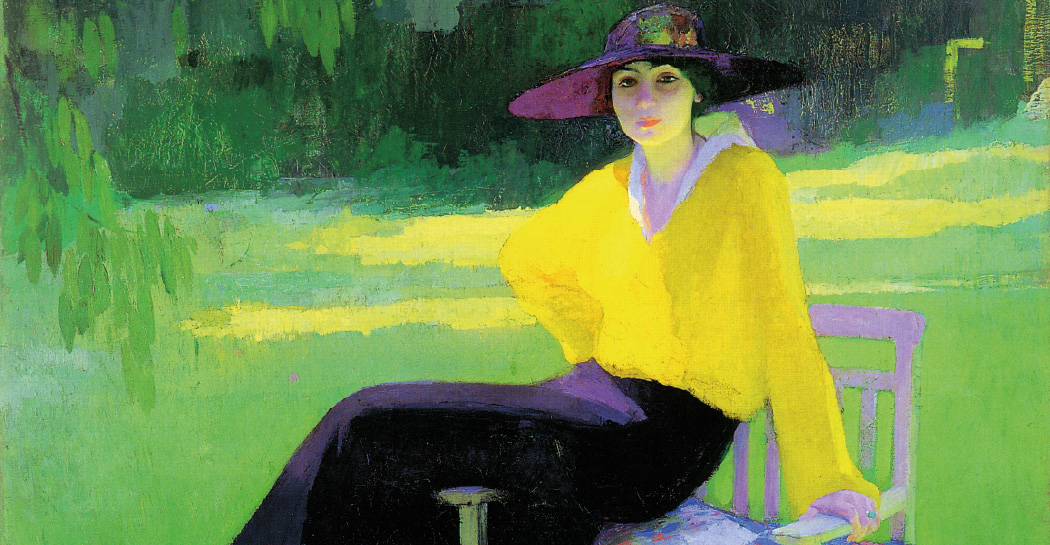
It was 28 October 1925 and in the halls of Palazzo Caffarelli on the Capitoline Hill the institution now known as the Galleria d'Arte Moderna came into being.
Exactly 100 years later, Roma Capitale celebrates the founding of its institution with the major exhibition GAM 100. Un secolo di Galleria comunale 1925 – 2025 at the current museum site on via Francesco Crispi, set up within the former convent of the Discalced Carmelites at San Giuseppe Capo le Case.
To date, the collection comprises over 3,000 works, including paintings, sculptures, drawings and prints, which document the artistic movements and trends of more than two centuries, from the 19th to the 21st century. The exhibition will help visitors find their way through these Italian and European experiences, moving from the late 19th century to the avant-garde such as Futurism; then Secession, the Scuola romana, Novecento and the Return to Order, continuing with the post-war period and the new canons of Abstraction, Informel and Neo-avant-garde.
The more than 100 selected works, including authentic masterpieces by artists of the calibre of Giacomo Balla, Carlo Carrà, Mario Sironi, Fortunato Depero, Antonio Donghi, Renato Guttuso, Giorgio de Chirico and Antonietta Raphaël Mafai, to name just a few, will form the ideal compass with which visitors can journey through a century of art and history, while retracing the evolution of the Capitoline Gallery through the venues, dates and key events that have affected it: from the inauguration in 1925 at Palazzo Caffarelli and the reopening in 1931 under the name Galleria Mussolini, curated by Antonio Muñoz, to the first Quadriennale in 1931 at Palazzo delle Esposizioni; from the rebirth at Palazzo Braschi in 1952 to the new home at Palazzo delle Esposizioni (from 1963 to 1972) curated by Carlo Pietrangeli. Up to the double inauguration of 1995 and 2011 at the current site. A century of change, transformation and upheaval whose sole aim has been to protect and enhance modern art.
From 24 June 2026 the exhibition route will be renewed. The display is enriched with a new selection of twenty-five paintings and sculptures, some of which replace works already on show and some of which are genuine additions, with the aim of revealing the richness of the museum's storerooms and opening new perspectives on a complex and fascinating history. Alongside the works already on display, by artists such as Balla, Casorati and Sironi, are thus added other great names in art history, such as De Nittis, Mafai and Severini, along with lesser-known figures who are nonetheless central to the evolution of the collection.