For the first time in three hundred years in Rome, a selection of masterpieces of 18th-century European architectural drawing
On display is a core group of drawings and sketches made by Italian and Saxon artists, held in the scientific collection of the Landesamt für Denkmalpflege Sachsen.
At the mid-18th century, Dresden – the capital of Saxony, famous as the "Florence on the Elbe" for the wealth of its artistic treasures – became one of the main centres of Italian culture north of the Alps, under the reign of the Prince Elector Friedrich August II (King of Poland as August III), and his consort Maria Giuseppa. Enthusiasts of Italy and of "opera seria", the royal couple did not limit themselves to collecting masterpieces of Italian painting, such as those by Raphael, Correggio, Giorgione or Titian, but attracted to Dresden many masters of the Bel Paese, among composers, singers, instrumentalists, poets, stage designers and theatre architects.
The intense cultural life at the Catholic court, in the diaspora of Protestant Saxony, was also decisively promoted by Italian Jesuits. A symbol of this Counter-Reformation period is the Cathedral of the Holy Trinity, inaugurated in 1751 to a design by the Italian architect Gaetano Chiaveri and considered "the most Roman building north of the Alps". Despite the damage suffered in 1945, the monument still characterises the urban landscape of Dresden today, while many of the Italian artists and craftsmen who contributed to its construction have also left their mark in other locations around Dresden and in Saxony.
The court of August III also attracted painters, stuccoists, musicians, dancers and theatre entrepreneurs from Italy, drawn by the splendour of the "Augustan Age". Among them stands out the court painter Bernardo Bellotto, known as Canaletto, native of Venice, whose magnificent views uniquely preserve the appearance of the city at that time. In parallel, scholars, painters and architects from Dresden undertook study trips to the South, some of long duration, bringing their impressions back home.
The exhibition draws on the scientific collection of the Landesamt für Denkmalpflege Sachsen, which holds numerous testimonies of these cultural exchanges, including masterpieces of 18th-century European architectural drawing. The exhibition presents a selection of architectural drawings and sketches, offering a glimpse of that extraordinarily fertile period culturally, to which Dresden primarily owes its enduring fame as a city of art and music.
While a comprehensive retrospective of paintings by Correggio from Italy is under way in Dresden, original 18th-century architectural drawings from Dresden are simultaneously being shown in Rome. Among them are works made right here in Rome three hundred years ago.
The exhibition is organised into four rooms. In the first room, entitled "Rome as Model", alongside a presentation of the city of Dresden, six drawings of interior details of the Roman churches of Sant'Ivo alla Sapienza, San Carlo alle Quattro Fontane and Ss. Trinità dei Monti, as well as of the Villa Albani, are on display. Two other particularly imposing sheets are the work of the future Saxon chief architect Julius Heinrich Schwarze, who in Rome copied the famous design of a domed church by Filippo Juvarra and transposed it to Dresden in a church design of his own.
The second room is dedicated to the construction of the new Catholic court church in Dresden, designed and built by the Roman architect Gaetano Chiaveri. Besides eight sheets by Chiaveri and other architects involved in the project, the main work of the room is the colour drawing of the Annunciation altar in Sant'Ignazio, made by the circle of Anton Raphael Mengs, which was to serve as a model for an altar in Dresden.
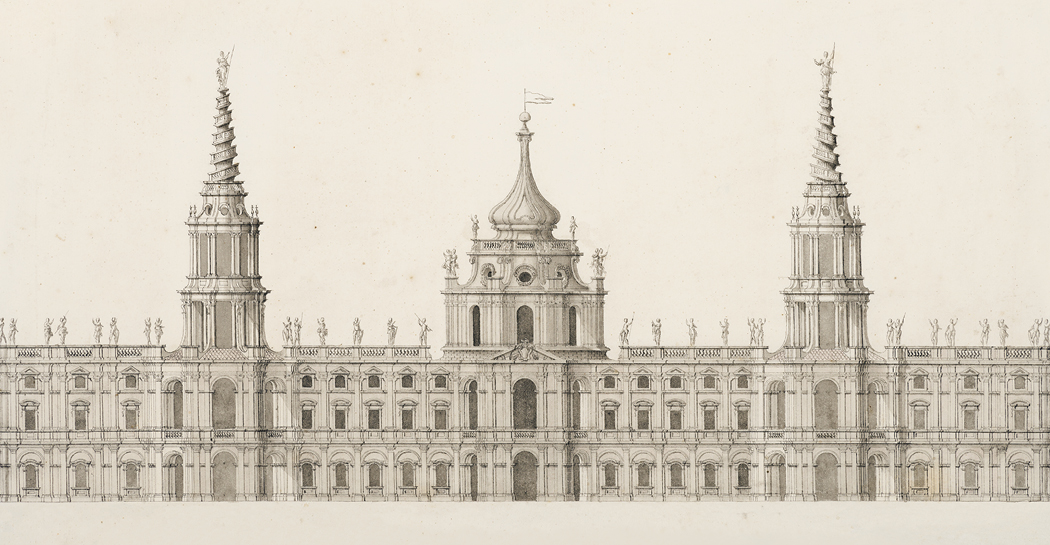
The third room is also dedicated to Gaetano Chiaveri. A total of ten drawings, some of extraordinarily large format, represent designs for a new royal palace for the Prince Elector of Saxony in Dresden.
The fourth room, finally, is entitled "The Italians in Dresden". Numerous Italian craftsmen and artists had been summoned to Dresden for the construction of the buildings. The twelve drawings in total show their designs for architecture and artistic decoration, but also their living conditions in the city. Particularly noteworthy are the designs by Giuseppe Galli Bibiena for the ceiling decoration of the Catholic court church and, as the highlight, a design by Giovanni Antonio Pellegrini for his painted decorations in the Zwinger in Dresden, considered the largest known drawing by the master.
Some of the works on display thus return, for the first time in almost three hundred years, to the place where they were made.