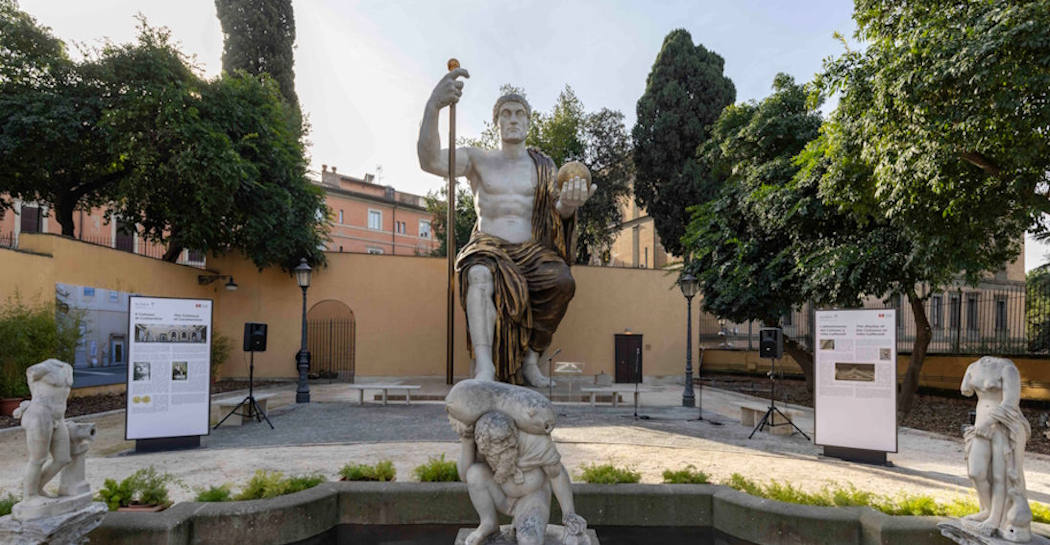
At the Capitoline Museums, in the garden of Villa Caffarelli, the imposing full-scale reconstruction of the Colossus of Constantine.
The statue, about 13 meters tall, has been created using innovative reconstruction techniques, starting from the original 4th-century AD pieces preserved in the Capitoline Museums.
Among the most important works of antiquity, at about 13 meters in height, the colossal statue of Constantine (4th century AD) is one of the most significant examples of late Roman sculpture. Of the entire statue, rediscovered in the 15th century at the Basilica of Maxentius, only a few monumental marble fragments remain today, housed in the courtyard of the Palazzo dei Conservatori at the Capitoline Museums: head, right arm, wrist, right hand, right knee, right shin, right foot, left foot.
From 6 February 2024, the extraordinary 1:1 scale reconstruction of the Colossus can be admired in all its imposing grandeur in the garden of Villa Caffarelli. The work was first presented in Milan from 17 November 2022 to 27 February 2023, on the occasion of the exhibition Recycling Beauty, curated by Salvatore Settis and Anna Anguissola with Denise La Monica.
The garden of Villa Caffarelli, where the replica of the Colossus of Constantine is located, partly occupies the area once taken up by the Temple of Jupiter Optimus Maximus, which housed the statue of Jupiter, perhaps the same one from which the Colossus was derived or which in any case served as its model. The remains of the temple are visible today inside the Exedra of Marcus Aurelius.
The reconstruction project for the colossal statue of Constantine began with an important archaeological, historical and functional analysis of the fragments, supported by the study of literary and epigraphic sources. The nine fragments in Parian marble, currently preserved at the Capitoline Museums, were discovered in 1486 inside the apse of a building then believed to be the Temple of Peace of Vespasian, which only at the beginning of the 19th century was correctly identified as the Basilica of Maxentius along the Via Sacra. They were thought to belong to a statue of the emperor Commodus and, given their exceptional importance, were displayed in the Palazzo dei Conservatori during the renovation works carried out to a design by Michelangelo between 1567 and 1569. The fragments were identified as a colossal portrait of the emperor Constantine only at the end of the 19th century. A tenth fragment, part of the torso, found in 1951, is about to be transferred from the Colosseum Archaeological Park to the courtyard of the Palazzo dei Conservatori, next to the other fragments. The archaeological study of the fragments has suggested that the Colossus was seated and was made as an acrolith, that is, with the nude parts in white marble and the drapery in metal or gilded stucco. According to an iconographic scheme typical of the time, which assimilated the emperor to the deity, Constantine is depicted as Jupiter, with the upper part of the body bare and the cloak draped over the shoulder; the right arm holds the long-shafted scepter and the left hand supports the globe.
At the end of March 2022, a team from the Factum Foundation spent three days in the courtyard of the Capitoline Museums scanning the fragments using photogrammetry. Each fragment was modeled in 3D and positioned on the digital body of the statue, created using as iconographic examples other imperial-era cult statues in similar poses, including the colossal statue of Jupiter (1st century AD) preserved at the State Hermitage Museum in St. Petersburg, probably inspired by Phidias’ Zeus of Olympia, and the large plaster copy of the statue of Emperor Claudius, depicted as Jupiter, displayed at the Ara Pacis Museum.
The complex reconstruction operation - watch the video La ricostruzione del Colosso - carried out by Factum took many factors into account: the type of marble of the original parts, the restorations and additions; the details of the missing drapery and the appearance of the gilded bronze of which it was made; the relationship between the reconstruction and the surviving fragments, their condition and their exact position. After completing the ultra-high-resolution 3D model, the material reconstruction of the Colossus proceeded. Resin and polyurethane, together with marble dust, gold leaf and plaster, were chosen to render the material surfaces of the marble and bronze, while an easily assembled and removable aluminum support was used for the internal structure (originally perhaps made of bricks, wood and metal bars). The final result allows us to admire, in a magnificent illusion, the Colossus as a whole, in which the “stitches” between the rematerialized parts and the copies of the original fragments in the courtyard of the Palazzo dei Conservatori are visually distinguishable.
In-depth content: - Il Colosso di Costantino - The Colossus of Constantine - Le vicende dei frammenti - The history of the fragments - L'allestimento del Colosso a Villa Caffarelli - The display of the Colossus at Villa Caffarelli - Il processo di ricostruzione - The reconstruction process
The digital reconstruction of the Colossus of Constantine