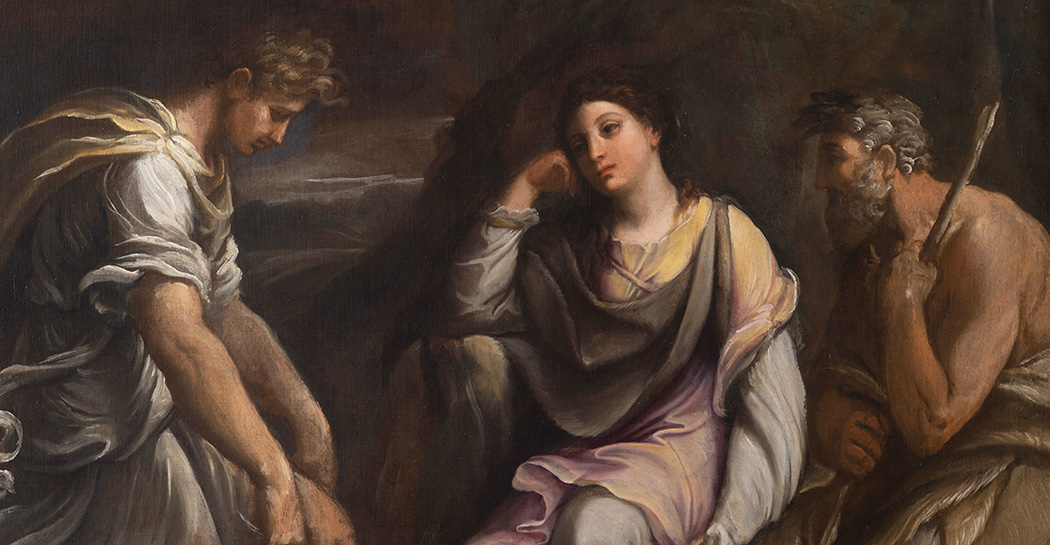
The exhibition project offers an unprecedented insight into the creative process of several unfinished paintings held at the Pinacoteca Capitolina, guiding the visitor to discover the phases of conception and execution of the works, highlighting second thoughts, changes and technical solutions adopted by the artists that are invisible to the human eye.
Subjected to scientific analysis through imaging, reflectography and spectroscopy tools, the works reveal the secrets of the technique with which they were made. This is the case of the painting Cristo e l'adultera (1525-1528) by Jacopo Palma il Vecchio, with the variants left visible for the gesture of Christ's hand, or of Guido Reni's canvas depicting the Anima beata (1640-1642), which the artist modified during execution by changing the position of the legs and wings, or of the various phases of execution in the paintings by Garofalo.
The exhibition route begins at the entrance to the Pinacoteca, where the visitor is welcomed by multimedia installations illustrating the investigative phases preliminary to the project, carried out with non-invasive methods on the paintings chosen by the team of the EAR WP2 project of the Accademia di Belle Arti di Roma, to show the work in progress, as if the artist were still at work.
A possibility well illustrated by the works housed in the Pinacoteca Capitolina, starting from Room II, where the unfinished work by Benvenuto Tisi called Garofalo is displayed, compared with a similar work from the Galleria Cantore in Modena. Thanks to the digital frames placed alongside the works, it is possible to virtually leaf through the photographs of the preparatory drawing, obtained through non-invasive diagnostic techniques, and understand the various phases of execution of the two paintings, possibly differentiated between master and workshop.
Continuing into Room III, the visitor encounters Cristo e l'adultera by Jacopo Palma il Vecchio. A work that constitutes a particular case study: more than a simple non finito, we are in fact faced with a work repainted to alter its original meaning. Left unfinished at the painter's death, it was partially repainted at a later date, leaving some parts unresolved. By leafing through the digital images, the visitor can observe the results provided by digital radiography, infrared reflectography, UV fluorescence and MA-XRF, which highlight the changes the work has undergone and the alterations made in the adulteress's gaze, in her hair and in the position of Christ's hand.
Room VI, entirely dedicated to Guido Reni, is the one that brings together the largest group of unfinished works in the Pinacoteca. Here the first digital frame illustrates the working phases of the early painting Silvio, Dorinda e Linco: while infrared reflectography shows a sketch executed with a liquid medium applied with a brush for the contours of the figures, radiography reveals a pictorial matter rich in lead white. The progressive dissolves between reflectographic images, radiographs and visible light allow the various phases of execution of the work to be followed. The second digital frame illustrates the making of the Anima beata, of which the Pinacoteca also preserves the sketch, an exceptional case for Guido Reni. The results obtained on both works show a very articulated process, rich in pentimenti, which continues relentlessly on the large canvas. The variations affect the entire figure, but also the posture of the body, the legs, the arms, the wings and the drapery. Finally, the comparison of the reflectographies of the final painting with a preparatory drawing for a Crucifixion, also by Guido Reni, was significant; the close correspondence of the figure and of the changes made to it leads to the hypothesis that the painter started from this drawing to develop the final project of the Anima beata. Accompanying Guido Reni's work is a 3D reproduction of the painting, intended to make it accessible also to people with visual disabilities and low vision.
Finally, still in close dialogue with the works held by the Pinacoteca, it is possible to admire the macrophotographs of the works Lucrezia, Cleopatra, Gesù Bambino e san Giovannino, extremely effective in showing the material brushstrokes laid down quickly by Guido Reni with a modelling ductus and an almost Impressionistic manner.
Il non finito: fra poetica e tecnica esecutiva therefore offers the visitor a feat: to delve into the artistic process in fieri thanks to the use of instruments and methodologies commonly employed for restoration work. Starting, however, from an intuition: diagnostics does not end in the field of conservation, but offers valuable tools for investigating creative processes and, in particular, the theme of the non finito. An aesthetic category that runs through the entire history of art from classical antiquity, if it is true that Pliny the Elder recalls how the unfinished Venus of Cos by Apelles was superior in expression and intensity to many well-finished works, and how none of the pupils dared to intervene to complete it. A suggestion and a modus operandi taken up by Leonardo, Michelangelo, Titian and Guido Reni, which involve the participation of the observer and reach as far as contemporary art, passing through the Impressionists. Faced with an incomplete work, the observer is stimulated on a neurological level and activates an imaginative compensatory mechanism, virtually continuing the creative action and sharing the artist's gesture.
The exhibition project represents one of the main results of the EAR - ENACTING ARTISTIC RESEARCH project (Work Package 2, directed by Costanza Barbieri), funded by the Ministry of University and Research through PNRR funds allocated to strategic partnerships and to the promotion of the internationalisation of research in the system of Higher Artistic and Musical Education of the Ministry of University and Research. The EAR project brings together the Accademie di Belle Arti of Rome (lead partner), Florence and Brera, the Conservatories of L'Aquila and Rome, in partnership with the INFN section of the University of Roma Tre and with the Università Politecnica delle Marche, with the aim of promoting the interaction between artistic research and scientific research.
The catalogue, published by Artemide Edizioni, gathers a series of essays by specialists on the non finito and non-invasive diagnostics, including writings by Carmen Bambach, Costanza Barbieri, Roberto Bellucci, Marco Cardinali, Maria Beatrice De Ruggieri, Cecilia Frosinini, Augusto Gentili, Sergio Guarino, Claudio Seccaroni, Luca Tortora.
Works on display: Pinacoteca entrance: Strigillated sarcophagus with busts of the spouses
Room 1: Benvenuto Tisi called Garofalo, Circoncisione Benvenuto Tisi called Garofalo, Circoncisione, (Loan from the Galleria Cantore, Modena)
Room 2: Jacopo del Palma, Cristo e l'adultera
Room 3: Guido Reni, Silvio, Dorinda e Linco, (Allegory of Rejected Love) Guido Reni, Gesù e San Giovannino Guido Reni, Maddalena penitente Guido Reni, Fanciulla con corona Guido Reni, Anima beata (sketch) Guido Reni, Anima beata 3D model, Anima beata (ABAfi) Guido Reni, Fanciulla con anfora Guido Reni, Lucrezia Guido Reni, Cleopatra Ludovico Carracci, Ritratto di giovane