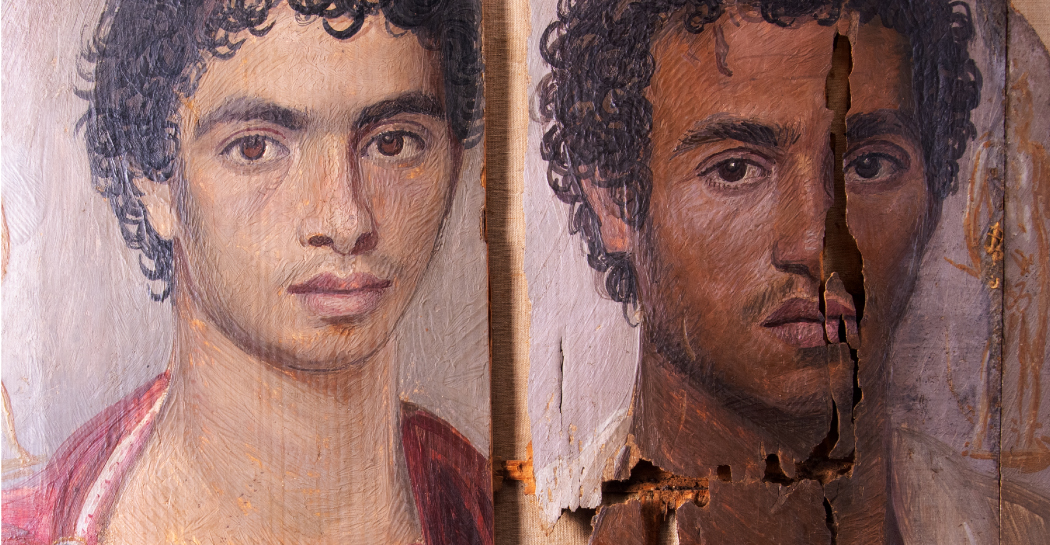
A fascinating comparison between ancient masks and portraits from El Fayum and other regions of Egypt
Through over 110 works, including panels, shrouds, funerary masks, marbles, plaster casts and ancient goldwork, the exhibition tells the story of one of the most fascinating artistic expressions of antiquity. The Fayum portraits are among the most famous painted images of antiquity and among the rarest in Italian museums: fewer than a thousand of them survive worldwide, wooden panels a few millimetres thick, painted in tempera or with the encaustic technique on a preparation of warm wax, and placed on the face of the deceased among the mummy's bandages. These are extremely delicate works, rarely lent: a unique opportunity to see such a substantial group brought together.
Few other civilisations of the past have left such vivid images of real people whom we can still look in the eye: the way the beard was cut, the earrings worn every day, the wrinkles counted one by one. But these faces that seem to come from a distant elsewhere are the fruit of the encounter between two great civilisations. The venue hosting the exhibition, the Museo dell'Ara Pacis, the monument commissioned by Augustus, also points to the Rome that had by then intertwined its destiny with that of Egypt.
These faces take shape in Egypt, which came within the orbit of Rome after the Augustan conquest, a cosmopolitan society in which Egyptian traditions, Greek culture and Roman models meet, mix and mutually transform one another. In this context, having one's portrait made meant not only preserving one's image, but asserting one's identity, one's status and the place occupied in society. Hence the choice that governs every room of the exhibition: never to isolate the painted face, but to relocate it within the dense weave of images, objects and customs from which it comes. In the faces painted, sculpted or modelled in stucco, in the long linen shrouds, we perceive a common air, in the hairstyles, in the fashion of the beards, in the jewellery similar to that actually found at Pompeii and Herculaneum.
The originality of these artefacts lies not only in their expressive quality, but also in the brief duration of the tradition that produced them. The Fayum portraits in fact belong to an artistic season that was intense but relatively short. In ancient Rome the portrait, mainly sculpted in stone, was an instrument of memory and social recognition: from the images of the ancestors of the republican elites to the many forms of self-representation of the imperial age, its use gradually extended to ever wider sections of society, until it included freedmen and new Roman citizens. In Roman Egypt it becomes a painted image, loses its corporeality and gains, through colour, an impression of real life. It is a use destined to last briefly: the production of panel portraits was concentrated between the 1st and 3rd centuries AD, before gradually dying out.
Almost 50 of those masterpieces painted two thousand years ago are on show in Rome, and the exceptional nature of the Roman project is measured by two groups of loans. For the first time Egypt is lending almost all the Fayum panels held in its own collections, never before removed from Egyptian museums, and with them the so-called Tondo of the Two Brothers, one of the greatest masterpieces of ancient painting, restored in Egypt by Italian restorers as part of the exhibition project.
From the Louvre Museum come twenty-three works, including panels and extremely rare painted linen shrouds, among them those from Antinoe (Antinopolis), exceptional for their state of preservation.
Alongside these extraordinary loans, the route is completed by the sumptuous Isidora, whose portrait - now in the Getty Museum - is so refined that it gave its conventional name to its anonymous painter, the Master of Isidora; the splendid Eirene from the Landesmuseum Württemberg in Stuttgart, whose name appears on the panel together with the prayer with which her loved ones entrust her soul to Osiris; the portraits from the Metropolitan and a youthful face never exhibited before, only recently emerged from the excavations of the Italian archaeological mission in Egypt of the Università del Salento.
The route opens with a prologue that sets the two civilisations face to face: on one side the Ptolemaic funerary mask from the Museo Barracco, a face still far from individual physiognomy, intended to guarantee access to the afterlife; on the other the marble portraits of the Musei Capitolini and the Centrale Montemartini. Between these two poles lie, as an anticipation of the encounter between different worlds and a promise of what the route reveals, the first Fayum faces, from Cairo, the Louvre and the Metropolitan.
Five sections follow.
With the aim of making museums places open to all and for everyone, and with the intention of encouraging the widest participation in the cultural life of the city, the Sovrintendenza Capitolina continues its commitment to equipping temporary exhibitions too with services that meet the different needs of the public and citizens, with various accessibility routes and attention to welcome and inclusion. The exhibition is in fact designed to be accessible thanks to collaboration with Rai Pubblica Utilità, with Fabio Fornasari, artistic director of the Museo Tolomeo, with the Department of Social Policies and Health - Personal Services Directorate of Roma Capitale and with the Segni d'Integrazione Lazio Cooperative.