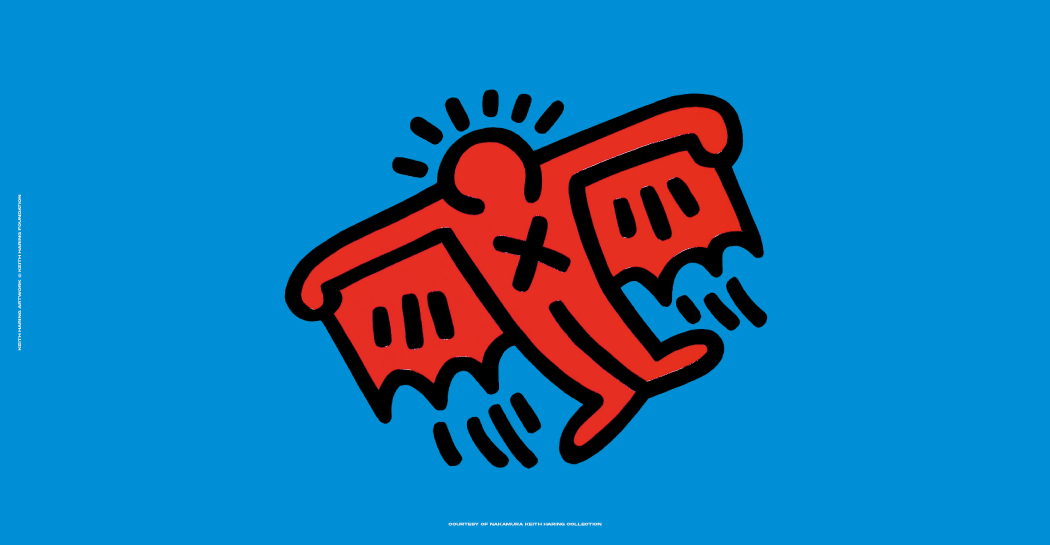
An exhibition devoted to one of the most recognisable figures of the second half of the twentieth century: an artist who turned the line into a public language, the street into high art and the image into a universal message.
The exhibition brings together more than 140 works and materials exceptionally lent by the Nakamura Keith Haring Collection, the largest collection in the world dedicated to the artist, alongside important public and private loans. On show, a kaleidoscope of techniques and languages reveals the full versatility of Haring: prints, works on paper, drawings, posters and sculptures sit alongside the celebrated Subway Drawings, with which the artist began his career drawing in chalk on the advertising panels of the New York subway, and the iconic panels spray-painted in 1984 along the FDR Drive motorway in Manhattan. The route is enriched by surprising objects on which Haring left his mark, such as the Yamaha motorcycle he painted during his stay in Rome in 1984.
In the turbulent New York of the 1980s, a city marked by violence, drugs and urban decay, Keith Haring drew inspiration from the raw energy of a pre-digital era, when ideas circulated through the streets, music, clubs and direct contact between people: the birthplace of hip-hop and street art, where art, activism and popular culture meet.
The exhibition traces Haring's artistic journey from his first works in New York to his political posters, sculptures, paintings and final works. Throughout his career Haring expanded his visual language while remaining faithful to a simple conviction: art must be accessible to everyone. Radiant children, barking dogs, dancing figures, angels, hearts, televisions and pyramids are more than recurring motifs: they form a universal visual alphabet that continues to speak to different cultures and generations. As Haring said: «The public has a right to art. Art is for everyone». This conviction remains at the heart of the exhibition.
The exhibition route opens like a journey back to the roots of a myth. Before becoming a global icon, Haring left his mark in Italy: in 1983 he held his first Italian solo show at the Galleria Lucio Amelio in Naples, for which he also created a work for Terrae Motus; in Milan he painted the Fiorucci flagship store; in Rome, in 1984, he painted a mural, now lost, on the facade of the Palazzo delle Esposizioni; in Pisa, in 1989, he left Tuttomondo, his last great gift to the world.
From here we return to the true origins of everything: the streets and subway of New York, where a piece of white chalk on an empty advertising panel becomes, every day, a small public miracle. «Drawing lives by magic», Haring wrote in 1978, and from that archaic magic the celebrated Subway Drawings are born, together with the panels spray-painted in 1984 along the FDR Drive motorway: works that carry Haring's mark well beyond the boundaries of the canvas.
The exhibition then builds, piece by piece, the visual grammar of the artist: with Icons, the 1990 series that gathers his most iconic figures (the Radiant Baby, the Angel, the Dog, the Winged Man), Haring composes an alphabet that can be read anywhere, by anyone. But this simple language hides a profound urgency: in the section devoted to political and social commitment, posters and works such as Free South Africa, Crack Down! and Safe Sex! turn the image into a public voice against racism, apartheid, nuclear war and AIDS. «I don't believe art is propaganda: it must liberate the soul», Haring said in 1985, and it is this freedom that guided the more than one hundred posters he created over the course of his life.
The route then becomes more intimate and physical: in the section "Radiant Eros – Celebrate Life", works such as the panels Bad Boys and the monumental Untitled of 1984, made with fluorescent pigments and presented under black light, speak of the body, desire and the joy of living as an act of resistance, at the height of the AIDS crisis. The same vital pulse runs through his relationship with music, between New York clubs and posters for festivals and records, where Haring's line becomes rhythm and dance. We then move into a more symbolic and spiritual dimension, where the Serpent, the Cross, the Angel and the Pyramid become a vocabulary capable of crossing different cultures and faiths, from African and pre-Columbian art to the Christian iconography Haring discovered during his stays in Rome.
The exhibition reaches its emotional peak with Apocalypse and Altarpiece: The Life of Christ, the two works in which Haring, now aware of his own end, looks more closely at death: first responding to the apocalyptic chaos of the writer William S. Burroughs, then turning to the form of the Christian altarpiece for his last, deeply personal reflection on faith and transcendence. The exhibition closes by returning to the simplest and most revolutionary conviction of Haring's entire research, the one that has run through every room, every work, every poster: «art is for everyone».
> Il percorso espositivo
> Guided tours on Saturdays and Sundays The route is accompanied by a structured educational programme designed for young people and schools, with activities that bring new generations closer to the artist's immediate, inclusive and participatory language. Alongside the educational activities, guided tours for adult audiences offer a journey into the world of Keith Haring: from New York street art to civic engagement, from iconic signs to the public, luminous and collective dimension of his work.
Guided tours led by specialist staff are available to individual visitors on Saturday afternoons and Sunday mornings. The schedule can be consulted online at: https://www.museodiroma.it/it/didattica/visite-guidate-il-sabato-e-la-domenica-alla-mostra-keith-haring Tours can be booked/purchased online, at the Ticket Office or by calling 060608.
Visits and creative workshops for primary and lower and upper secondary schools can be booked by calling 060608 and will soon be available to view on the website: https://www.museodiroma.it/it/didattica/didattica_per_le_scuole