Solo exhibition by Venezuelan photographer and journalist Fabiola Ferrero, winner of the XVI Premio IILA-Fotografia.
The exhibition, dedicated to the memory of the thousands of victims and missing persons of the earthquake of 24 June 2026 in Venezuela, takes the form of a journey through the visible and invisible fractures that run through the history, memory and identity of a country, but also as a reflection on the capacity of images to preserve what risks disappearing and to question the established narratives of the past.
The title, Las grietas – the cracks, in Spanish – refers to the material fissures that mark buildings and monuments, those produced by natural disasters and social transformations, but also to the intimate fractures that run through memories, bodies and the sense of belonging. Through four fundamental chapters of Ferrero's production – Whispering Walls, I Can't Hear the Birds, Reinas and Contramonumento – the exhibition route weaves together the consequences of the earthquakes in Venezuela, the memory of a country profoundly transformed by emigration, the myth of beauty as a promise of progress, and the relationship between monumentality, power and the female body in the city of Rome.
The route opens with Whispering Walls, a project that documents the searches among the rubble following the double earthquake that struck northern Venezuela. Through the stories and testimonies of rescuers, Ferrero conveys the dramatic dimension of the catastrophe, while also highlighting the extraordinary capacity for organisation and the supportive response of civil society. The images investigate what remains after the collapse: destroyed buildings, surviving objects, traces of suddenly interrupted lives. The rubble is not only the remains of an architecture, but holds fragments of existences and family stories. Particularly significant are the images of statues damaged inside an earthquake-struck church, with their faces ruined and partly covered by fabrics, and a photograph of two elegant couples compromised by the rubble. These elements introduce one of the central themes of the entire exhibition: the tension between the human desire to preserve and immortalise an image and its inevitable exposure to destruction. The cracks become the sign of a collective wound, but also the point from which to rebuild a shared memory.
With I Can't Hear the Birds, Ferrero turns her gaze towards a more intimate and autobiographical dimension. The project arises from a return to the places of childhood and family memory, in a Venezuela profoundly transformed by crisis, mass emigration and the loss of the prosperity that had fuelled the national imagination throughout the twentieth century. The photographer explores the spaces and traces of a lost nation, confronting an inevitably incomplete memory, in which personal recollections, family history and collective transformations overlap. Nostalgia becomes a form of research, an attempt to reconstruct a sense of belonging through what survives change. Emigration represents one of the great fractures of the project: geographical distance is accompanied by temporal and emotional distance, while the return reveals the impossibility of finding intact the world that was left behind. Awarded the World Press Photo in 2023 in the Long Term Projects category for the South America region, I Can't Hear the Birds constitutes one of the most significant chapters of Ferrero's research into the cultural and human consequences of the transformations of contemporary Venezuela.
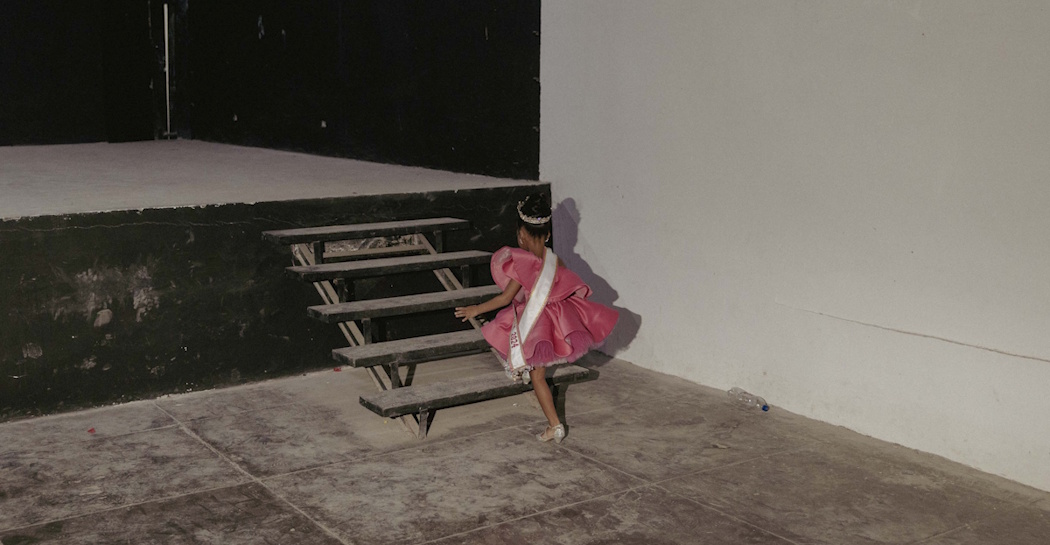
With Reinas, the artist addresses one of the most recognisable phenomena of the Venezuelan imagination: the cult of beauty and the centrality of beauty pageant queens. The project investigates its historical and cultural roots, relating them to the modernisation of the country and the economic abundance generated by the oil industry. In twentieth-century Venezuela, oil helped shape a collective imagination founded on the idea of progress, prosperity and modernity. Within this symbolic universe, the figure of the beauty queen assumed a role that goes beyond the aesthetic dimension, becoming the embodiment of a national ideal, a promise of recognition, belonging and social mobility. Ferrero observes this imagination in its contradictions, questioning the relationship between the representation of perfection and the complexity of social reality. Beauty emerges as a cultural construction, a collective fiction in which individual aspirations, models of success and desires for transformation are reflected. In dialogue with the rest of the exhibition, Reinas introduces a reflection on the relationship between body and representation: the female figure, transformed into a symbol of perfection and prestige, ideally enters into relation with the celebratory statues of Rome, which were also conceived to embody ideals of beauty, power and permanence.
The route concludes with Contramonumento, the project conceived and carried out by Fabiola Ferrero during the artist residency in the Capital, provided for by the XVI Premio IILA-Fotografia. Presented to the public for the first time, the work represents a new chapter in the artist's research and the point of convergence of the reflections developed in the three Venezuelan projects. In Rome, Ferrero confronts a city in which historical memory is inscribed in urban space through monuments, statues and celebratory architecture. Marble, a material associated with duration and permanence, becomes the starting point for questioning the relationship between the representation of power and the vulnerability of the body. The photographer brings the surfaces of Roman statues into dialogue with the fragility, time, ageing and intimate resilience of the female body. Classical monumentality, an expression of a predominantly male historical narrative, is observed from a perspective that questions its claim to eternity. The statues, seemingly immutable, also bear the marks of time: fractures, abrasions, mutilations and transformations. The title Contramonumento suggests an overturning of perspective: attention shifts from heroism to ordinary existence, from celebration to memory, from the ideal of perfection to the concrete presence of bodies. The city is stripped of its rhetorical solemnity to reveal a more fragile and human dimension.
The exhibition is accompanied by a catalogue published by Gangemi Editore, with an original text by Marco Delogu, which explores in particular the dialogue between the artist's Venezuelan production and this new work made in Rome.
PREMIO IILA FOTOGRAFIA
The exhibition is part of the Premio IILA-Fotografia, an award established in 2008 by IILA – Organizzazione Internazionale Italo-Latino Americana to promote contemporary Latin American photography and support the integration of young talents into the international artistic and cultural circuit.
Aimed at emerging photographers under 40 from the Organisation's member countries, the Award promotes the languages of contemporary photography in Latin America, offering opportunities for visibility, professional growth and international exchange. Through support for artistic production, exhibition opportunities and residency experiences, it constitutes a tool of cooperation and cultural dialogue between Italy and Latin America.
The artist residency in Rome represents a particularly significant moment of this path, offering artists the opportunity to confront Italian reality directly and develop new projects. Contramonumento, made by Ferrero within this experience, concretely demonstrates the Award's capacity to generate new artistic productions through intercultural dialogue.
Fabiola Ferrero (Caracas, 1991) is a Venezuelan documentary photographer and journalist whose work explores the cultural legacies of the modernisation of Venezuela in the twentieth century, fuelled by the oil industry. With training in writing and investigative journalism, she develops long-term photographic projects addressing themes related to politics, history, collective memory and national identity.
At the centre of her research is the way in which oil helped shape the Venezuelan imagination, influencing ideas of progress, beauty, religion and belonging. Through a language that interweaves documentary investigation and personal dimension, Ferrero explores the consequences of the country's economic and social transformations, paying particular attention to the traces of the past and to the processes through which individuals and communities build their own memory.
In 2021 she founded Semillero Migrante, a mentoring programme aimed at young photographers in Latin America, with the aim of democratising access to photographic education and fostering the professional growth of emerging talents.
In 2018 she was a Fellow of the Magnum Foundation within the Photography and Social Justice Program, and in 2022 she served on the jury of the World Press Photo for the South America region. Among her main awards are the Carmignac Photojournalism Award in 2021, the World Press Photo 2023 in the Long Term Projects category for I Can't Hear the Birds, and the Deloitte Photo Grant for Reinas. She was also a Fellow at the Institute for Ideas and Imagination of Columbia University in Paris for the period 2023–2024.
In 2025 she won the XVI Premio IILA-Fotografia with the project Looking for the Olive Trees, and in 2026 she received a grant from the National Geographic Society as a National Geographic Explorer.
www.fabiolaferrero.com